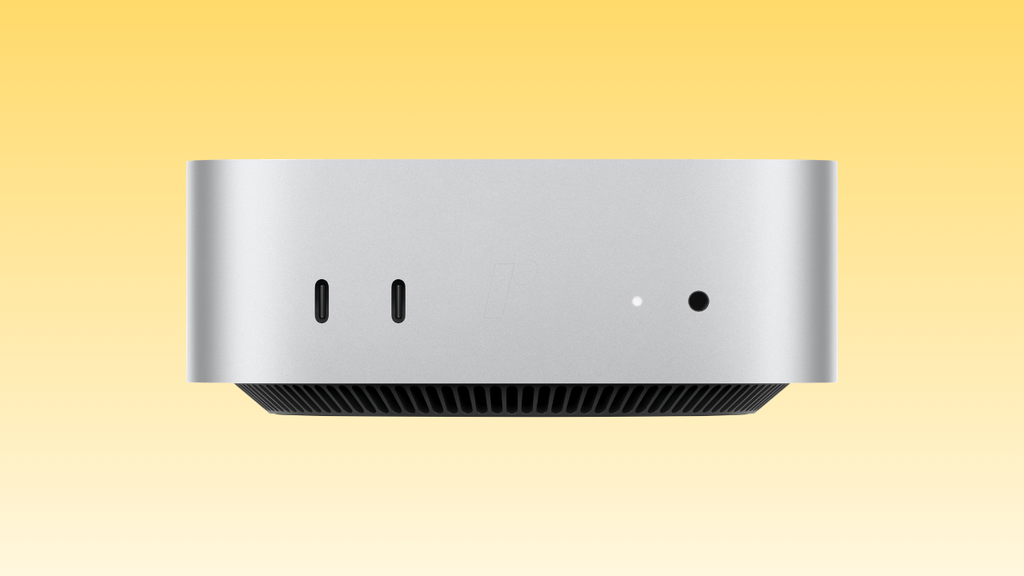
Apple just launched a new Mac mini, and for the first time it’s coming in two very different flavors: a standard M6 model and a higher-end M5 Pro configuration. Pre-orders open today, August 25, with the new Mac mini shipping September 22. This isn’t a minor spec bump either, Apple’s calling M6 its first chip built on a 2-nanometer process, and the performance claims attached to it are genuinely large.
The M6 model gets a 12-core CPU and 12-core GPU, both up two cores from the outgoing M4, plus a new Dual 16-core Neural Engine and Neural Accelerators built into every GPU core. Apple claims up to 40% faster CPU performance, 2x faster graphics, 2x faster storage, and a striking 4x faster AI performance compared to M4. In LM Studio specifically, Apple says prompt processing runs up to 4.8x faster than M4 and 13.5x faster than the original M1. Memory starts at 16GB and tops out at 32GB, with bandwidth up to 170GB/s, useful headroom for running local AI models without hitting a wall.
The M5 Pro is where things get genuinely serious. Configurable up to an 18-core CPU, 20-core GPU, 64GB of unified memory, and 307GB/s of memory bandwidth, nearly double the M6’s ceiling. Apple’s positioning this squarely at professional workloads: video rendering, 3D design, VFX, app development, large local AI models, the kind of work that actually needs that memory headroom. Apple’s benchmark claims here include up to 8.5x faster LLM prompt processing than M2 Pro and 4.5x faster Blender ray tracing over the same chip.
Connectivity got a real upgrade across both models: Wi-Fi 7, Bluetooth 6, and 2.5Gb Ethernet standard with a 10Gb option. Ports differ by tier, though. The M6 model sticks with three Thunderbolt 4 ports around back, while the M5 Pro gets three Thunderbolt 5 ports instead, so if that specific standard matters to your workflow, it’s Pro-only this generation.
What ties this whole launch together is how hard Apple’s leaning into AI positioning. This isn’t being framed as just a faster desktop, Apple’s repeatedly describing it around “agentic AI,” local LLMs, AI agents that can automate tasks on-device, and workflows that run entirely locally rather than depending on the cloud. That framing lines up with where Apple’s clearly steering its whole product line alongside macOS 27 and its next-generation Apple Intelligence and Siri AI push.
Physically, nothing’s changed, Apple kept the same ultracompact form factor rather than redesigning the case, all that extra compute is just packed into the same footprint as before.
If you’re weighing which model to get: the M6 covers everyday use, creative work, and lighter AI tasks comfortably, while the M5 Pro’s only worth the jump if you’re actually running demanding professional workloads or want serious headroom for larger local AI models. For most people upgrading from an M4 or older Mac mini, the standard M6 is going to be plenty.

M Adnan Akram is the founder and lead writer at Phoonomo, covering mobile technology with a primary focus on Apple and the broader smartphone industry, alongside emerging developments in AI. He follows product launches, spec leaks, and industry trends closely to keep readers informed with timely updates.
Discover more from Phoonomo
Subscribe to get the latest posts sent to your email.