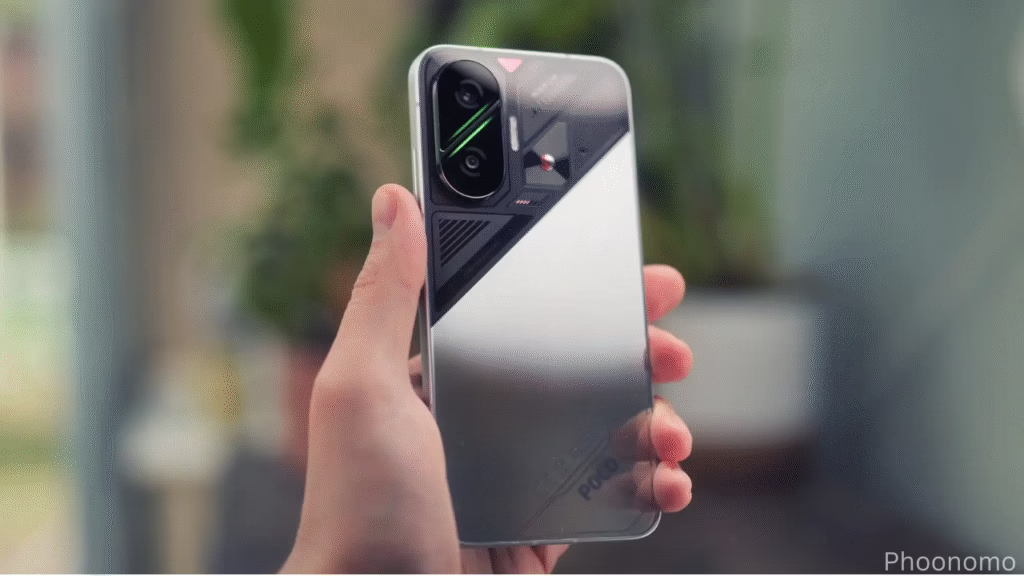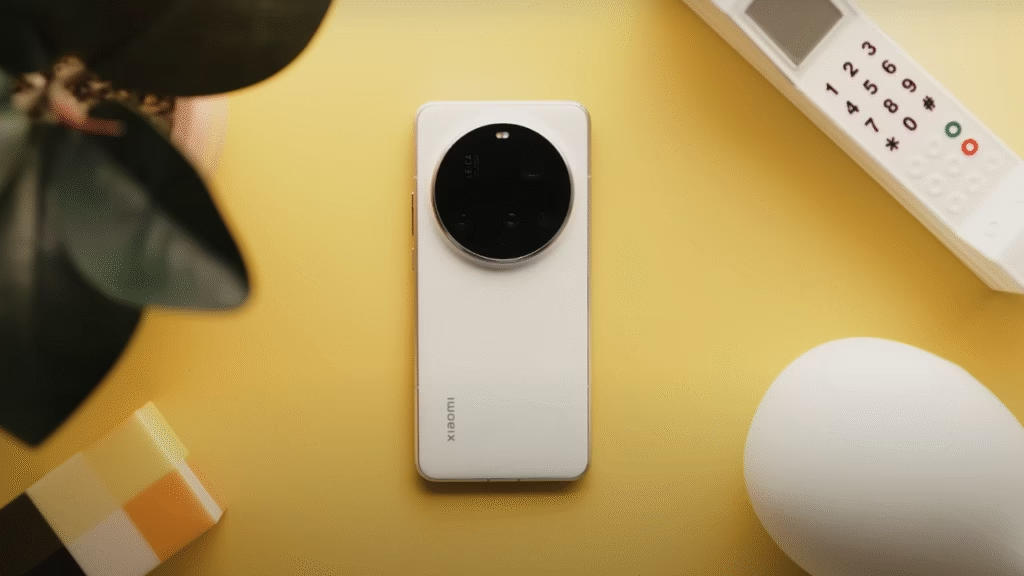
Xiaomi has taken the Redmi Note 17 lineup global, and the move brings a fourth model into the family that wasn’t part of the original China launch back on July 14. Where that debut introduced just the Redmi Note 17 and Redmi Note 17 Pro, the international rollout adds the Redmi Note 17 Pro Max 5G and a 4G variant of the base Note 17 for select markets, bringing the total to four phones.
The Pro Max Is the One to Watch
The Redmi Note 17 Pro Max 5G is clearly the centerpiece of this launch, and the reason comes down to one number: a 10,000mAh battery paired with 100W HyperCharge. Xiaomi claims that’s enough for roughly three days of typical use, and the company says the silicon-carbon cell retains 80% of its capacity after 1,600 charge cycles, a figure aimed squarely at buyers who keep phones for years rather than upgrading annually.

There’s a regional wrinkle worth flagging, though. The 10,000mAh figure applies to a single-cell configuration sold in some markets, while the European version reportedly ships with a 9,210mAh dual-cell setup instead. So depending on where you buy it, “10,000mAh” might not be the number printed on your specific unit’s spec sheet.
The rest of the Pro Max leans into durability rather than camera muscle. It’s rated for 3-meter drop resistance and IP69K protection, alongside a 6.83-inch OLED display under Gorilla Glass Victus 2, a Snapdragon 6 Gen 5 chip, up to 12GB of RAM, and up to 256GB of storage in at least one reported configuration. The camera setup, a 50MP main sensor with an 8MP ultrawide and a 32MP selfie camera, is comparatively modest for a phone positioned as the flagship of the range. That’s a deliberate trade-off: Xiaomi is selling this phone on endurance and toughness, not photography.
Note 17 5G and Note 17 Pro 5G Round Out the Lineup

The standard Redmi Note 17 5G is the battery-life play at a lower price point. It packs a 6.99-inch AMOLED display running up to 120Hz with 1,800 nits of peak brightness, a Snapdragon 4 Gen 4 chip, 6GB or 8GB of RAM, and 128GB of storage. Its own silicon-carbon battery comes in at 8,000mAh with 45W charging, still enough for Xiaomi to advertise 3+ days of use, and it carries the same 1,600-cycle, 80%-capacity durability claim as its bigger sibling.
Sitting between the two, the Redmi Note 17 Pro 5G bumps the display up to a sharper 1.5K-class 6.83-inch AMOLED panel with peak brightness up to 3,500 nits, a noticeably brighter screen than the base model. It moves to a Snapdragon 6s Gen 4 chipset, offers RAM configurations reportedly up to 12GB, storage up to 512GB depending on market, and a 9,000mAh battery with 67W charging, splitting the difference between the base phone’s efficiency focus and the Pro Max’s charging speed.
Pricing Is Still a Patchwork
Global pricing so far looks region-dependent rather than fixed. The Redmi Note 17 Pro Max 5G is reportedly landing around the $499 mark in some markets, while Singapore’s launch pricing starts as low as SGD 319 during a promotional window, with the standard Note 17 5G’s 6GB/256GB configuration priced at SGD 449 normally and SGD 399 on promotion. Pakistan pricing hasn’t been officially confirmed by Xiaomi yet, so any specific rupee figures circulating right now should be treated as estimates rather than final numbers.
What stands out about this launch is how little the camera matters to Xiaomi’s pitch. In a price segment where megapixel counts and lens arrays usually do the talking, the Note 17 family is betting that a battery you don’t have to think about for three days, wrapped in a body that can survive drops and dust, is the feature people actually want. Whether that’s enough to stand out against competitors chasing camera specs in the same price range is the real test once reviews start rolling in.

M Adnan Akram is the founder and lead writer at Phoonomo, covering mobile technology with a primary focus on Apple and the broader smartphone industry, alongside emerging developments in AI. He follows product launches, spec leaks, and industry trends closely to keep readers informed with timely updates.
Discover more from Phoonomo
Subscribe to get the latest posts sent to your email.