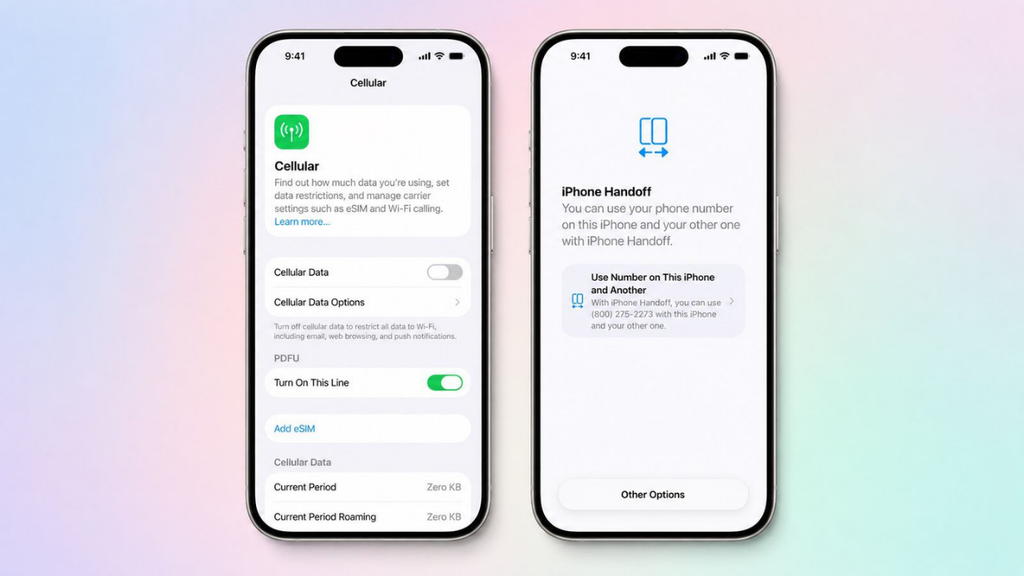
Apple quietly slipped a feature called iPhone Handoff into its WWDC 2026 slide of hundreds of iOS 27 changes back in June, described in one line as the ability to switch between two iPhones with the same phone number. It went largely unnoticed until a MacRumors forum member named pdfu posted a video this week showing exactly how it works, running on two simulated iPhones inside Xcode 27’s Device Hub. MacRumors was first to detail the demonstration, and its report forms the basis of most of what’s known about the feature so far.
The setup happens in Settings > Cellular, where one iPhone gets designated the main device and the other becomes the companion. The main iPhone hangs onto your existing eSIM, while the companion receives what Apple calls a companion eSIM, tied to that same number rather than a separate one. From there, the phone actively being used becomes the one associated with the cellular line, while the other sits passive. One clip from the demo reportedly even shows a Dynamic Island alert popping up when service moves over to the other handset.
It’s a genuinely different mechanism from Apple’s long-running Handoff feature, which lets you pick up a Safari tab, an email draft, or a document on another Apple device. That version moves an activity between devices; iPhone Handoff moves the cellular identity itself, closer to what carriers already offer through MultiSIM plans, except here Apple is building the switching mechanism directly into the OS rather than leaving it entirely up to the network.
Cellular settings stay locked to the main iPhone throughout, so the two devices aren’t fully independent accounts, more of a primary-and-secondary arrangement. Location sharing follows the same logic: whichever iPhone is actively holding the line is the one Find My Contacts see, which avoids the awkward scenario of a location ping coming from a phone sitting untouched in a drawer.
Software alone won’t turn this on. Both iPhones need to run iOS 27, they have to share an Apple Account, and critically, the carrier has to support the underlying provisioning, the same kind of eSIM infrastructure Apple leaned into with the iPhone 17 lineup going eSIM-only in more markets. T-Mobile in the US and Deutsche Telekom in Germany have turned up in the carrier configuration data as likely early supporters, though neither has made it official yet, and there’s no indication so far that AT&T, Verizon, or any Pakistani carrier is on board at launch.
The obvious appeal is for people who juggle two iPhones, a work and personal device, an older phone kept for travel, or a reviewer switching handsets constantly, all without maintaining two separate numbers or manually reinserting an eSIM every time. What it isn’t is a way to run both phones simultaneously on the same line, or a shortcut for pairing two unrelated Apple Accounts. Apple hasn’t said anything about Android support either, and nothing in the current demo suggests it’s coming.
iOS 27 is expected within days, following roughly three months of beta testing after building on the steady stream of smaller updates iOS 26 picked up along the way, including iOS 26.2 earlier this year. What’s still missing is a full carrier list, any word on pricing, and clarity on how the setup behaves when one of the two phones is roaming abroad. Those details should firm up once the public release actually lands.

M Adnan Akram is the founder and lead writer at Phoonomo, covering mobile technology with a primary focus on Apple and the broader smartphone industry, alongside emerging developments in AI. He follows product launches, spec leaks, and industry trends closely to keep readers informed with timely updates.
Discover more from Phoonomo
Subscribe to get the latest posts sent to your email.