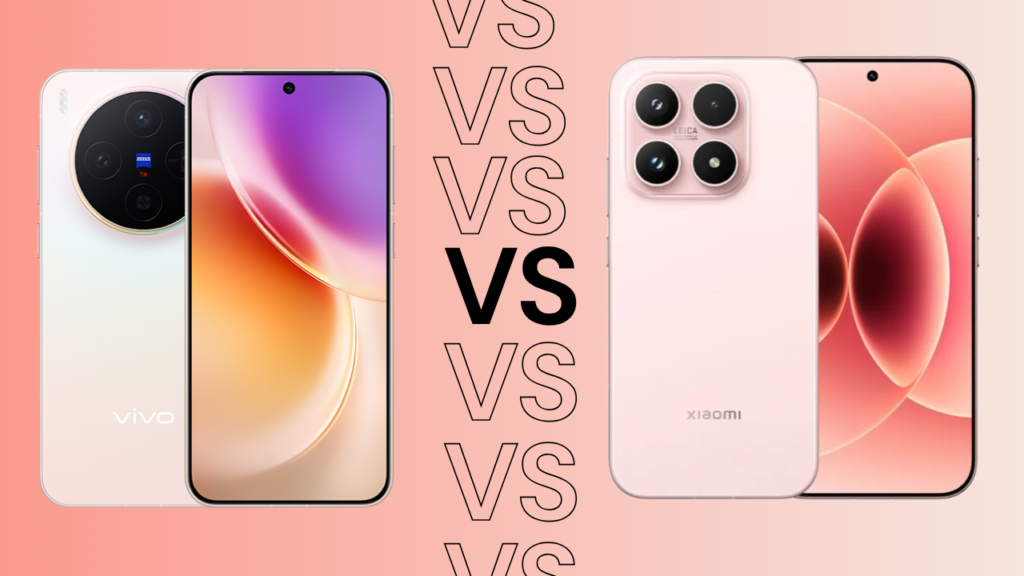
Two phones. Two very different philosophies. One genuinely interesting fight. The Xiaomi 17 vs Vivo X300 is the compact flagship comparison of 2026 that most people didn’t see coming and the result is messier, more nuanced, and more interesting than any spec sheet comparison would suggest. One costs significantly more. One has cameras that embarrass phones twice its price. Neither is perfect. And that’s exactly what makes this worth talking about.
Small Win for Xiaomi
Both boxes are nearly identical in terms of what you get inside. But Xiaomi edges ahead with a transparent hard shell case that’s noticeably tougher than what Vivo includes. The charging brick is also slightly heftier on the Xiaomi at 100W compared to Vivo’s already generous 90W. Small things, but when you’re paying a significant premium for the Xiaomi 17, you notice them. The value meter starts at near zero for Xiaomi’s premium and it’ll have to earn its way up from there.
Design Both Are Compact, But Different to Hold
This is one of the most confusing parts of the comparison because these two phones look surprisingly similar. Same compact form factor, almost identical weight, opposite ends of the color wheel. You could genuinely mistake one for the other from across a room.
Pick them both up though and the difference reveals itself. The Xiaomi 17 is slightly more comfortable to hold the off-center camera placement and higher camera plateau work naturally for one-handed use and eliminate the wobble problem when the phone sits flat on a table. It’s a small thing that you stop noticing until you switch back to the Vivo and suddenly miss it.
Vivo does win on water resistance. IP69 versus IP68 meaning the X300 can handle an 80°C high-pressure water jet that the Xiaomi technically can’t. In practical daily life, IP68 is already more than enough. Full submersion protection at IP68 covers everything most people will ever encounter. The IP69 advantage is real but academic for the vast majority of users.
Both phones score identically here. The design round goes to personal preference more than anything objective.
Display Xiaomi’s 12-Bit Panel Changes Things
Both displays are genuinely excellent. AMOLED panels, striking colors, deep contrast, full LTPO support with 1Hz to 120Hz adaptive refresh, HDR10 Plus support on both. Side by side, they look similar enough that most people would struggle to pick a winner blindfolded.
But Xiaomi has a real technical advantage here: a 12-bit color panel capable of displaying close to 69 billion colors versus around 1 billion on the Vivo’s 10-bit screen. In practice, the difference isn’t something you’ll notice watching YouTube or scrolling Instagram. It matters more in professional content work or when color accuracy is the priority.
The Vivo X300 has higher peak brightness on paper, but the real-world consistency of that brightness is inconsistent, sometimes clearly brighter than the Xiaomi, other times almost identical. It reads like a software optimization issue rather than a hardware limitation, which makes it more frustrating because the display is clearly capable of better.
Both support full DC dimming for comfortable low-light use. Xiaomi edges this round eight points to Vivo’s seven but it’s closer than the spec sheet suggests.
Speakers This Is Where Vivo Falls Behind
If you’ve only ever used the Vivo X300, you’d think the speakers were perfectly fine. And they are for a mid-range phone. The problem is sitting next to the Xiaomi 17, which sounds noticeably richer, louder, and more immersive. Lower frequencies that the X300 simply drops, the Xiaomi 17 reproduces with genuine depth.
The difference becomes especially clear watching anything with a proper soundtrack. Details in the lower frequency range that disappear on the Vivo come through clearly on the Xiaomi. It’s not subtle once you hear it side by side and once you’ve heard it, you can’t unhear it.
Vivo also falls behind on sheer volume. It gets loud enough, but the Xiaomi gets louder while maintaining audio quality. This is one of the clearest wins for the Xiaomi 17 in the entire comparison, nine points versus five for Vivo. A significant gap that adds real points to Xiaomi’s value argument.
Performance Snapdragon Wins, But With Caveats
The Xiaomi 17 runs the Snapdragon 8 Gen 5, the fastest mobile chip currently available. The Vivo X300 runs MediaTek’s Dimensity 9500. The general market consensus says Snapdragon wins, and Geekbench results confirm it for the most part.
In normal daily use messaging, browsing, streaming, social media you won’t notice a meaningful difference. Both phones handle everything without hesitation. But push them into intensive gaming and the story gets more interesting and more complicated.
Early in a gaming session, Xiaomi is clearly smoother. After about two minutes though, the Vivo starts running hot particularly around the camera area and upper frame and performance drops noticeably. Frame rates fall toward 21 FPS on the Vivo during extended sessions. The Xiaomi holds up better in sustained performance, with smaller, more consistent frame drop windows rather than cliff-edge drops.
The back-to-back Geekbench stress test makes the performance gap impossible to ignore. Single-core performance drops 7% on Xiaomi versus 9% on Vivo. But multi-core is where it gets genuinely damaging for the X300, a 9.7% drop on Xiaomi compared to a 31.3% drop on Vivo. That’s a massive thermal throttling gap that matters for anyone who uses their phone heavily for gaming or processor-intensive tasks.
Xiaomi takes this round eight points to Vivo’s seven. The Snapdragon advantage is real, particularly in sustained performance under load.
Software Neither Is Perfect, But One Is Better
Haptics are strong on both phones. Xiaomi’s are slightly stronger and more importantly better utilized throughout the software. Basic interactions like locking, unlocking, clearing notifications, and scrolling feel more complete and considered on the Xiaomi. On Vivo, the same interactions feel slightly unfinished, like the haptic feedback was added as an afterthought rather than designed into the experience.
Vivo’s software has some genuinely puzzling UX decisions. The widget center placement is one example: it gets triggered when you add new widgets, which is fine. But then it remembers that state and opens the widgets tab instead of the apps page on subsequent swipes. It’s the kind of small annoyance that builds up over days of use.
Xiaomi feels more refined in daily interactions opening apps, closing apps, and navigating between screens. The animations are smoother and more consistent. AI features are also broader on the Xiaomi 17, available system-wide rather than restricted to specific apps like Notes. The live translator with automatic language recognition is particularly useful for travel.
Vivo fights back with more advanced AI image recognition searching for “white flower” inside the gallery actually works on the X300, while the Xiaomi returns null results for the same query. Vivo’s AI eraser is also faster and slightly more accurate for smaller objects. But overall, Xiaomi’s software polish wins eight points to Vivo’s six. Vivo’s software issues are real and consistent enough to matter.
Connectivity Almost Equal
Both phones support Wi-Fi 7, Bluetooth 6.0, LDAC, USB 3.2 Gen 1 with external display support, and solid network performance. The Xiaomi 17 steps slightly ahead with AEX adaptive codec support and Oracast compatibility useful if you own specific premium audio equipment. Vivo supports AEX but not the adaptive variant.
Worth noting: the extra Qualcomm codecs on the Xiaomi aren’t something Xiaomi engineered specifically; they come standard with any Snapdragon flagship chip. So it’s less of a feature advantage and more of a byproduct of the chipset choice that was already scored in the performance section.
Ten points to Xiaomi, nine to Vivo. A close round.
Battery Basically a Draw
The Xiaomi 17 carries a 6,330mAh battery versus 6,040mAh on the Vivo X300. Both extract roughly seven to eight hours of screen-on time using about 85% of the battery’s genuinely full-day performance for most users.
The one interesting finding from testing: Vivo is slightly more efficient during standby with AOD active. Over a 5-hour 16-minute period, the Xiaomi 17 dropped 5% with AOD on about 1% per hour. The Vivo X300 dropped only 2% over the same duration. It’s a small single use-case finding rather than a decisive verdict, which is why this round ends in a draw. Eight points each.
Cameras Vivo Wins, and It’s Not Close
This is the section that defines the entire comparison. And the conclusion is clear: the Vivo X300 has significantly better cameras than the Xiaomi 17 for the money 9.5 points to Xiaomi’s 7.
Image clarity on the X300 is on another level. Even without shooting at the maximum 200MP resolution, every leaf, every fine texture looks more natural and more detailed on Vivo. Push to full 200MP and the gap becomes impossible to argue with. The ultrawide camera difference is particularly stark. Xiaomi’s ultrawide uses fixed focus, which is a surprising omission at this price point, while Vivo’s focuses properly and produces sharper results.
Night photography goes predominantly to Vivo better hardware quality across ultrawide and telephoto cameras overcomes Xiaomi’s processing advantages in most scenarios. The main camera actually goes to Xiaomi at night because of its larger sensor size and dedicated night video mode, but the rest of the camera system favors Vivo clearly.
Portrait mode on the X300 is genuinely exceptional, edge detection has improved significantly from earlier versions and the Zeiss bokeh is some of the most cinematic available on any compact flagship. Vivo is the king of portraits in this category without serious competition.
Macro photography is also more versatile on the X300, thanks to close focus distance across all cameras combined with the high main sensor resolution.
The one practical advantage Xiaomi holds in cameras is HEIC file format support. A 50MP image takes around 3MB on Xiaomi versus 8MB on Vivo. Over hundreds of photos, that storage difference adds up meaningfully. Vivo simply doesn’t support the format.
Final Verdict
The Xiaomi 17 is the better phone overall. Better speakers, better sustained performance, more refined software, and a chipset that handles heavy use more consistently. For someone who wants a compact flagship that does everything competently and feels premium in every interaction Xiaomi is the answer.
But here’s the thing. The Vivo X300 is the better value. It costs significantly less, and for the one area most flagship buyers care about most cameras it wins decisively. Portrait photography, macro, ultrawide, and night telephoto all go to Vivo. The software issues are real but livable. The speaker gap matters if audio is important to you.
If cameras are your priority, buy the Vivo X300. If overall balance and performance matter more, pay the premium for the Xiaomi 17. Neither decision is wrong but only one of them is better value for money in 2026.
Discover Also Galaxy S26 vs iPhone 17 The Truth From Someone Who Actually Owns Both

M Adnan Akram is the founder and lead writer at Phoonomo, covering mobile technology with a primary focus on Apple and the broader smartphone industry, alongside emerging developments in AI. He follows product launches, spec leaks, and industry trends closely to keep readers informed with timely updates.
Discover more from Phoonomo
Subscribe to get the latest posts sent to your email.