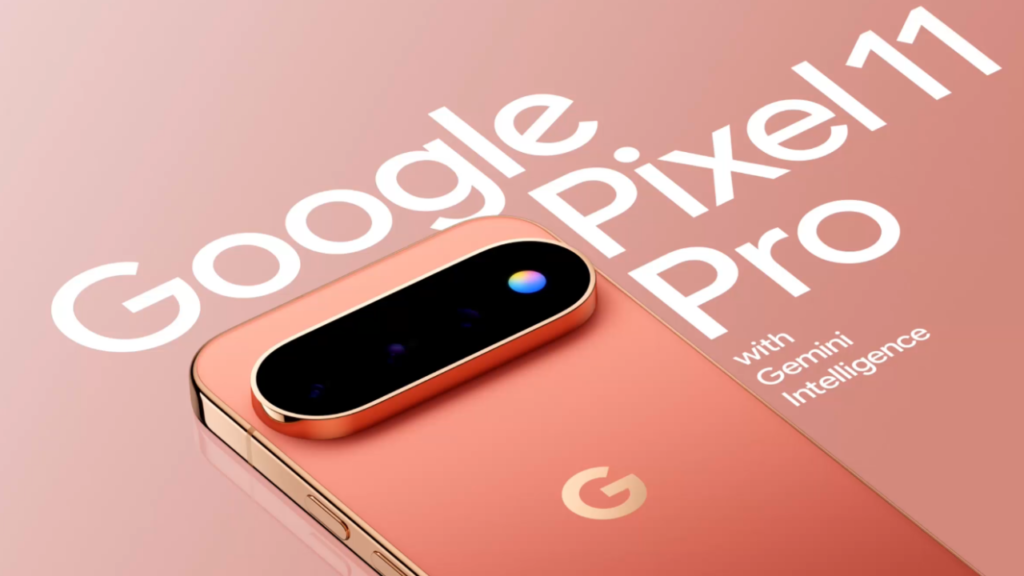
Google just unveiled its biggest Pixel lineup yet, and the changes go well beyond a new chip. The Pixel 11 series brings a brighter display class, a genuinely thinner foldable, a completely new AirTag-style tracker, and a health-focused Pixel Watch 5, all built around Google’s new Tensor G6 platform. Between four phones, a watch, and a tracker, this is less a phone launch and more Google restating its whole hardware strategy at once.
Pixel 11
The standard Pixel 11 is the new entry point into the lineup, starting at $899 with 256GB of base storage and 12GB of RAM, a meaningful jump from previous base-model storage tiers. It runs on the new Tensor G6 chip and picks up a thinner camera bar along with three new colors: Frost, Hibiscus, and Pistachio. The overall shape stays familiar, Google isn’t reinventing the Pixel silhouette, but the refinements make it look less like a straight repeat of last year’s design.
Battery life gets a real claim attached to it this time, with Google promising more than 30 hours per charge. Wireless charging also moves to Qi2.2, which Google says is roughly 25% faster than before, a small but genuinely useful upgrade for anyone who tops off overnight or during the day. On the camera side, the Pixel 11 gets a new 48MP main sensor with better light capture, zoom reaching up to 30x, and a new feature called Camera Looks that lets users apply different processing styles to photos without digging into manual settings.
Pixel 11 Pro and Pixel 11 Pro XL
The Pro and Pro XL are Google’s traditional premium tier, priced at $1,099 and $1,299 respectively, both starting at 256GB and scaling up to 1TB with 16GB of RAM on the higher-storage configurations. Both are reportedly $100 more expensive than last year’s equivalents, which puts Google in the same boat as most of the phone industry this cycle, absorbing rising component costs by passing some of it along.
The headline spec here is brightness. Google says the Pro displays now reach up to 3,600 nits peak brightness, a significant jump over the previous generation and enough to make outdoor visibility a genuine selling point rather than an afterthought. The camera system got a comparable upgrade, with a 50MP main sensor, a 48MP telephoto, and zoom reaching an aggressive 120x, alongside faster Night Sight processing and better stabilization for both stills and video.
The most unusual addition on the Pro models is HiLight, an RGB LED system built into the phone that can flash different colors for different notification types and tie into Gemini and your contacts. It’s a genuinely new idea for a flagship phone rather than an iteration on an existing feature, and it’s the kind of thing that will either become a signature Pixel touch or get ignored entirely depending on how useful people find it in daily use.
Pixel 11 Pro Fold
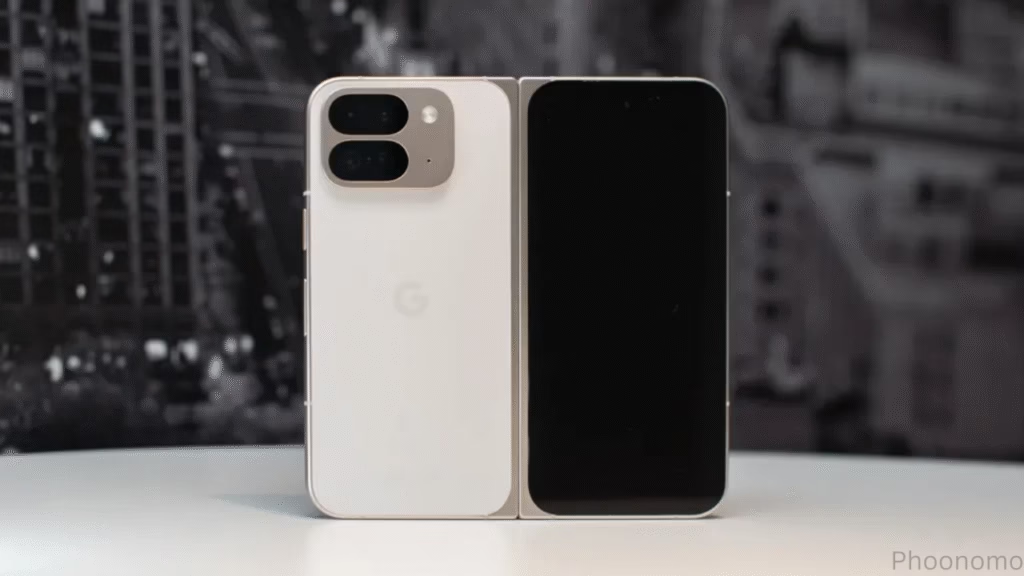
Google’s second-generation foldable starts at $1,899, with 256GB of base storage and 16GB of RAM standard. The focus this generation is clearly on making the device feel less like a compromise and more like a normal flagship that happens to fold. That means thinner bezels, an improved hinge mechanism, better overall durability, and IP68 water and dust resistance, a rating foldables have historically struggled to reach given their moving parts.
Camera hardware carries over the same 48MP main sensor and computational photography improvements found across the rest of the lineup, so Fold buyers aren’t getting a stripped-down experience the way earlier foldable generations sometimes did. Brighter displays round out the changes, matching the broader push toward higher peak brightness across the Pro-tier lineup.
Tensor G6
Every phone in the lineup runs on the new Tensor G6 platform, and Google’s messaging around it is notably different from a typical chip pitch. Rather than leading with raw benchmark numbers, Google is emphasizing AI processing, energy efficiency, camera processing, and on-device Gemini performance. That’s consistent with where Tensor chips have generally focused since Google took over silicon design, prioritizing the specific workloads Pixel software actually uses over general-purpose speed. Google also added upgraded security hardware alongside the new chip, though specifics on that front were light during the announcement.
Camera and Creator Features
Beyond the hardware, Google introduced a handful of software features aimed squarely at people who shoot a lot of photo and video content. Magic Capture can pull a usable still photo out of previously recorded video, useful for anyone who’s ever missed the right moment because they were filming instead of shooting stills. Camera Looks, mentioned earlier for the base Pixel 11, extends across the lineup as a quick way to apply processing styles without manual adjustment.
For video, Pro Stable Video adds support for recording up to 8K with improved stabilization, and a new Creator Suite bundles additional editing tools directly into the camera app. Google also added a built-in teleprompter feature, a clear nod to the growing number of people using their phones as their primary content-creation tool rather than a traditional point-and-shoot camera.
Gemini and AI
AI is the throughline across the entire event, tied into everything from HiLight’s contextual notifications to camera processing and live translation. Google is pushing Gemini deeper into the core Pixel experience rather than treating it as a bolted-on assistant, and purchases of the Pro models reportedly come with six months of Google AI Pro included, based on event coverage.
Pixel Watch 5
Alongside the phones, Google introduced the Pixel Watch 5, starting at $399 and available in two sizes. The focus is squarely on health and fitness, with new Breathing Emergency Detection, sleep breathing-quality tracking, expanded workout features, and broader health monitoring overall. Google also announced a Pixel Watch 5 Curry Edition, arriving September 3 at $579, a premium variant sitting well above the standard model’s price.
Pixel Tag
The biggest surprise of the event might be Pixel Tag, Google’s long-rumored answer to Apple’s AirTag, finally shipping November 11 at $29 for a single tag or $99 for a four-pack. It uses Google’s Find Hub network, the same crowdsourced device network Android already relies on for lost-device tracking, and supports both Bluetooth 6.0 Channel Sounding and Ultra Wideband for precise direction and distance finding. It’s rated IP67 for dust and water resistance, uses a replaceable CR2032 battery Google says lasts more than a year, and weighs around 12 grams in a grayish Fog finish.
Pixel Buds Pro 2 and Pixelsnap
Rounding out the announcements, the Pixel Buds Pro 2 gain improved Active Noise Cancellation and a new Olive color option designed to match the Pixel 11 Pro’s aesthetic. Google also expanded its Pixelsnap magnetic accessory ecosystem with a new Ring Stand and a Charger with Stand, both built around the same magnetic charging system introduced on last year’s Pixel phones.
| Product | Starting price | Key highlight |
| Pixel 11 | $899 | Tensor G6, 12GB RAM, 256GB |
| Pixel 11 Pro | $1,099 | 3,600-nit display, 120x Pro Zoom |
| Pixel 11 Pro XL | $1,299 | Larger premium Pixel |
| Pixel 11 Pro Fold | $1,899 | Thinner foldable, IP68, 16GB RAM |
| Pixel Watch 5 | $399 | New health features |
| Pixel Watch 5 Curry Edition | $579 | Special edition |
| Pixel Tag | $29 | Google’s AirTag competitor |
| Pixel Tag 4-pack | $99 | Four trackers |
| Pixel Buds Pro 2 | $229 | Improved ANC + Olive color |
Taken together, this is Google treating the Pixel lineup less like a yearly phone refresh and more like a full ecosystem push, phone, watch, earbuds, and now a tracker, all leaning on the same AI and Gemini backbone. If you’ve been holding off on buying into Pixel because the accessory lineup felt incomplete next to Apple’s, Pixel Tag closes that specific gap, and everything else here suggests Google is done treating hardware as a side project to its software.

M Adnan Akram is the founder and lead writer at Phoonomo, covering mobile technology with a primary focus on Apple and the broader smartphone industry, alongside emerging developments in AI. He follows product launches, spec leaks, and industry trends closely to keep readers informed with timely updates.
Discover more from Phoonomo
Subscribe to get the latest posts sent to your email.