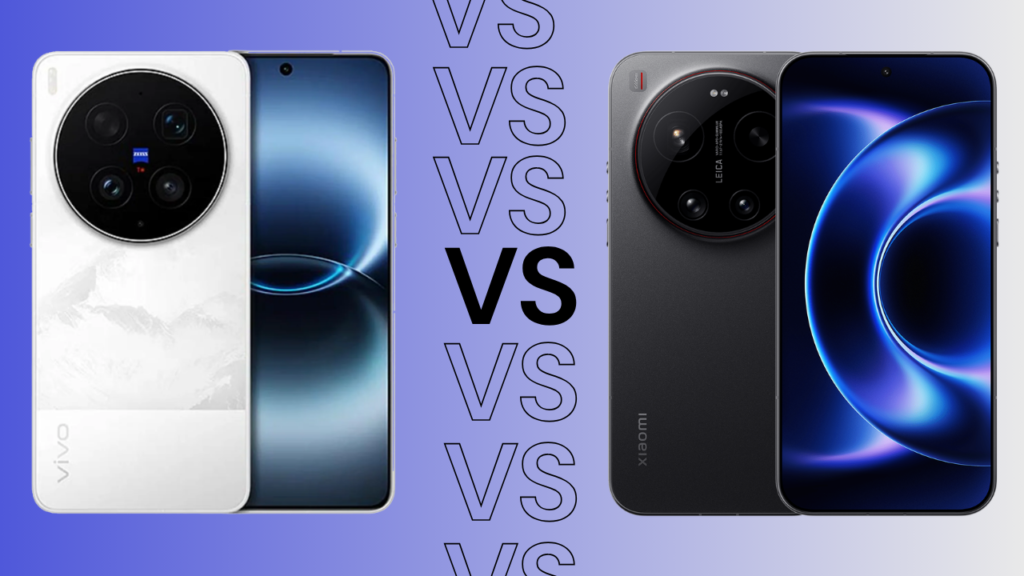
Both of these phones cost serious money. Both run the same Snapdragon 8 Elite Gen 5 chip. Both have triple cameras with 200MP telephoto sensors. On paper, they look like they’re playing the same game.
They’re really not.
Spend some time with the actual specs and a clear picture emerges. The Vivo X300 Ultra is built for photographers who want the most capable camera system money can buy in Android right now; it is, in many ways, a camera with a phone attached. The Xiaomi 17 Ultra is the more balanced flagship with better battery life, lighter body, lower price, and still an absolutely world-class shooter. Understanding which one fits you comes down to knowing what you’re actually going to use.
Design and Build Lighter vs. Tougher
The Vivo X300 Ultra comes in at 232–237g depending on which version you get. That’s a heavy phone. The Xiaomi 17 Ultra is noticeably lighter at 218–223g, nearly 15 grams less, which doesn’t sound massive until you’re holding the phone for two hours straight.
Dimensions are close, both sit around 163mm tall and 77mm wide, and both hover around 8.2–8.5mm thick. Neither is a slim phone, but neither is unreasonable for what’s packed inside.
Where they differ more meaningfully is build material and water resistance. Both carry IP68 and IP69 ratings so both handle submersion and high-pressure water jets. But the Xiaomi 17 Ultra adds aerospace-grade glass fiber reinforcement to its structure, and it’s rated for submersion up to 6 meters for 30 minutes versus the Vivo’s 1.5 meters. The Xiaomi genuinely takes durability more seriously at the structural level.
The Vivo X300 Ultra uses aluminum and glass throughout. The Xiaomi offers glass-fiber reinforced plastic or eco-leather back options depending on the variant which splits opinion but keeps weight down and adds a different feel in the hand.
Both have no headphone jack, both use USB-C 3.2, and both have infrared blasters, NFC, and Wi-Fi 7. These are fully loaded flagship builds.
Display Vivo Has the Edge Here
The Vivo X300 Ultra runs a 6.82-inch LTPO AMOLED panel at 1440 x 3168 pixels that works out to roughly 510 ppi. It supports 144Hz, Dolby Vision, HDR10+, and 2160Hz PWM dimming for eye comfort. In real-world brightness testing it hit 1,935 units measured. Resolution nerds will appreciate this panel. 510 ppi is genuinely sharp, noticeably so when reading text or viewing detailed images.
The Xiaomi 17 Ultra runs a slightly larger 6.9-inch LTPO AMOLED at 1200 x 2608 pixels 416 ppi. It also does 120Hz (not 144Hz like the Vivo), Dolby Vision, 2160Hz PWM, and claims 3,500 nits peak. But measured brightness in independent tests came in at 1,132 nits considerably lower than the Vivo’s 1,935 nits measured figure.
So the Vivo has higher resolution, higher real-world brightness, and a higher refresh rate. If you’re picking on display alone, the X300 Ultra wins. The Xiaomi panel is still excellent, it just isn’t the better screen between the two.
Both have under-display ultrasonic fingerprint sensors, both cover the full range of HDR standards, and both have protective glass Vivo uses Armor Glass (Mohs level 4) while Xiaomi uses Xiaomi Shield Glass 3.0.
Cameras This Is Where Things Get Really Interesting
Both phones have a triple rear camera setup with a 200MP periscope telephoto. Everything else is where they diverge.
The Vivo X300 Ultra leads with a 200MP main camera a 1/1.12-inch sensor at f/1.9 with gimbal OIS. That’s a massive sensor for a primary camera, and gimbal stabilization rather than standard OIS is a meaningful upgrade for handheld video. It then has a second 200MP periscope telephoto at 3.7x optical zoom with a 1/1.4-inch sensor, and a 50MP ultrawide with OIS and dual-pixel PDAF. That last detail matters OIS on the ultrawide is still relatively rare and makes a real difference for wide shots in lower light.
The Vivo also supports optional add-on zoom lenses 200mm and 400mm Zeiss optics which is a genuinely unusual feature for a smartphone. It’s a system play, not just a single device.
The Xiaomi 17 Ultra takes a different approach for the main camera. It uses a 50MP 1.0-inch type sensor at f/1.7. One inch. That’s an extremely large sensor, one of the largest in any current smartphone which means significantly more light capture even at lower resolution. More light in equals better low-light performance and more natural background separation. This is Leica-tuned and represents Xiaomi’s philosophy that sensor size beats megapixel count on the primary lens.
The Xiaomi telephoto is a 200MP periscope with a variable zoom ring 3.2x to 4.3x continuous optical zoom which is a flexible and useful mechanical feature. The ultrawide is 50MP but lacks OIS, which is one area the Vivo clearly wins.
For selfies, the Vivo has a 50MP f/2.5 shooter. The Xiaomi has a 50MP f/2.2 slightly wider and slightly more light-gathering. Both support AF and 4K video from the front.
In terms of video, both shoot 8K at 30fps and 4K at up to 120fps. The Xiaomi goes further on slow-motion ; it can shoot 1080p at up to 1920fps, which is exceptional for slow-motion capture. The Vivo supports 4K at 120fps and 1080p at up to 240fps. Both support 10-bit Dolby Vision HDR recording.
Which camera system wins overall really depends on your shooting style. Want the highest resolution main and telephoto cameras with gimbal stabilization and an OIS ultrawide? Vivo. Want a more natural, large-sensor primary camera with Leica color science and insane slow-motion video? Xiaomi.
Performance Dead Heat on the Chip, Differences Elsewhere
Both phones use the Snapdragon 8 Elite Gen 5 on TSMC’s 3nm process with the Adreno 840 GPU and UFS 4.1 storage. In benchmark terms they’re extremely close to AnTuTu v10 scores of 2,723,397 for the Vivo and 2,777,490 for the Xiaomi. Geekbench 6 gives the Vivo 11,494 versus the Xiaomi’s 10,896. 3DMark Wildlife Extreme: Vivo 7,075, Xiaomi 6,948. Essentially identical in performance, with the Vivo edging ahead by a small margin.
RAM options differ. The Vivo X300 Ultra offers 12GB or 16GB configurations. The Xiaomi 17 Ultra starts at 16GB with no 12GB option so you’re always getting the maximum. Storage goes up to 1TB on the Vivo and 1TB on the Xiaomi. Both are properly loaded.
The Vivo’s top 1TB/16GB model gets one exclusive feature: Emergency SOS via satellite for calls and messages. If you’re someone who travels to remote areas, that’s worth knowing.
Battery and Charging Xiaomi Runs Longer, Vivo Charges Faster
This section has a clear winner and a clear trade-off.
The Vivo X300 Ultra has a 6,600mAh battery (6,400mAh in Europe). It charges at 100W wired, 40W wireless, and supports reverse wireless charging. In active use testing, it scored 15 hours and 45 minutes solid for a phone with a high-resolution display running at 144Hz.
The Xiaomi 17 Ultra has a 6,000mAh battery smaller on paper but it scored 19 hours and 9 minutes in active use testing. That is a significant difference. Nearly four extra hours of active use from a smaller battery. Xiaomi’s software and power management are clearly doing more with less.
However, the Vivo charges faster 100W wired versus the Xiaomi’s 90W wired. The Vivo also matches 40W wireless versus the Xiaomi’s 50W wireless so the Xiaomi actually edges the Vivo on wireless charging speed despite having lower wired speeds. Both support reverse wired and reverse wireless charging.
If all-day and into-the-evening battery life matters most, the Xiaomi pulls ahead meaningfully. If you want the fastest wired top-up, the Vivo has a slight edge.
Audio and Extras
Both phones have stereo speakers rated “Very Good” in independent loudspeaker tests the Xiaomi scored -24.1 LUFS and the Vivo scored -24.7 LUFS (lower LUFS = louder). Small differences, both sound good.
Both support 24-bit/192kHz Hi-Res audio. Xiaomi adds Hi-Res Wireless. Both have infrared blasters and NFC. Neither has a headphone jack.
The Vivo’s Zeiss optics and T* lens coatings are worth mentioning as a differentiator; these aren’t just branding. Zeiss certification involves real lens quality standards that affect flare resistance and color accuracy. The Xiaomi’s Leica partnership serves a similar purpose but with different color tuning Leica leans toward rich, natural tones.
Price This Gap Is Hard to Ignore
The Xiaomi 17 Ultra starts at €1,279 / £1,199. The Vivo X300 Ultra is priced at €1,999.
That’s a €720 gap. For most people, that’s a very hard number to justify when the Xiaomi delivers better battery life, a more durable build, a larger selfie aperture, 50W wireless charging, and benchmarks that are essentially identical.
The Vivo’s case for the extra money rests on: the higher-resolution main camera, the OIS ultrawide, the 144Hz display, gimbal stabilization, higher real-world brightness, and the optional add-on Zeiss lenses. If you’re a serious photographer who’s going to push the camera system to its absolute limits and possibly buy those lens accessories, the X300 Ultra is built for you.
For everyone else spending serious money on a 2026 flagship, the Xiaomi 17 Ultra is the more sensible package.
So Which One Should You Buy? (Xiaomi 17 Ultra vs Vivo X300 Ultra)
Get the Vivo X300 Ultra if you’re a dedicated camera enthusiast who wants the absolute best resolution on every lens, gimbal OIS, a 144Hz QHD display, and doesn’t mind paying €1,999 for the most complete photography hardware available on Android right now.
Get the Xiaomi 17 Ultra if you want a flagship-level camera phone with Leica color science, a giant 1-inch main sensor, nearly four extra hours of battery life in real use, a lighter body, better durability rating, and you’d rather put the €720 difference toward something else.
Both are exceptional phones. But value even at this price tier still matters, and the Xiaomi 17 Ultra makes a genuinely strong case.
Discover Also Pixel 10 vs iPhone 17 Apple Just Stole Google’s Whole Identity

M Adnan Akram is the founder and lead writer at Phoonomo, covering mobile technology with a primary focus on Apple and the broader smartphone industry, alongside emerging developments in AI. He follows product launches, spec leaks, and industry trends closely to keep readers informed with timely updates.
Discover more from Phoonomo
Subscribe to get the latest posts sent to your email.