Qualcomm just made budget and mid-range Android a lot more interesting. Both new chips land on 4nm, bring serious gaming upgrades, and push features that were flagship-only just two years ago down to phones most people can actually afford.
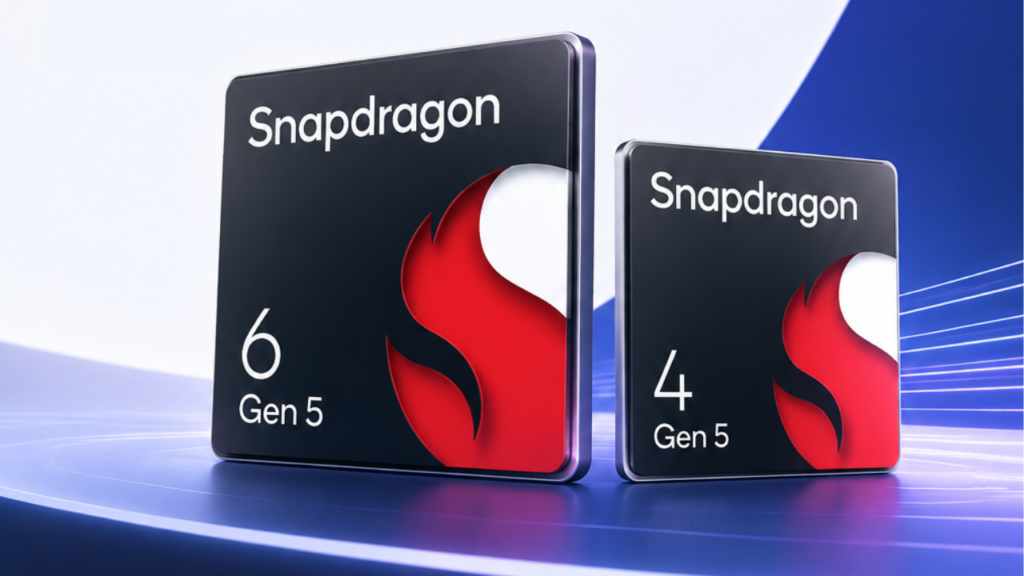
Flagship chips grab the headlines, but the chips that actually matter to most people are the ones sitting inside $200 to $400 phones. That’s the market Qualcomm is targeting today with the official launch of the Snapdragon 6 Gen 5 and Snapdragon 4 Gen 5. And looking at the numbers Qualcomm is putting out particularly that 77% GPU jump on the 4 Gen 5 this is a bigger generational step than the names suggest.
The 4 Gen 5 numbers are the ones worth stopping on. A 77% GPU improvement is not a typical generational bump that’s a significant architectural jump. And 43% faster app launches on a budget chip is the kind of real-world improvement that changes how a phone feels in daily use, not just in a benchmark. Qualcomm is also specifically calling out 90FPS gaming support on the 4 Gen 5, a first for the entire 4-series line, and something most budget phone buyers have never had access to before.
Wi-Fi 7 and Bluetooth 6.0 in mid-range. That’s new.
The connectivity story on the 6 Gen 5 is arguably its biggest headline. Wi-Fi 7 and Bluetooth 6.0 were firmly flagship territory until very recently. Pushing both down to upper mid-range devices in a single generation is a meaningful move. Wi-Fi 7’s multi-link operation means faster, more stable connections even in crowded environments like offices or apartments with a lot of competing signals.
On top of that, the 6 Gen 5 brings Qualcomm’s Adaptive Performance Engine 4.0, Game Super Resolution, and Elite Gaming features a suite that’s been proven on higher-end chips. 200MP camera support and 144Hz display compatibility round out a spec sheet that would have looked ambitious for a mid-ranger just two years ago.
Budget gaming phones have always been a compromise. You get the game running, barely, at 60FPS, with frame drops that remind you what tier of hardware you’re on. The 4 Gen 5’s 77% GPU jump and 90FPS support changes that conversation entirely. Entry-level Redmi, realme, and OPPO devices in H2 2026 running this chip should handle popular titles like BGMI, Free Fire, and Genshin Impact noticeably better than anything in their price range has before.
The Dual SIM Dual Active (DSDA) 5G support is also worth noting both SIM cards can be active on 5G simultaneously, which matters a lot in markets like India and Southeast Asia where dual-SIM use is the norm rather than the exception.
Confirmed brands for H2 2026
These are exactly the brands that dominate the sub-$300 Android market globally particularly across South Asia, Southeast Asia, and parts of Europe. When Redmi and realme build around a new chip, it reaches tens of millions of buyers within a single launch cycle. The practical reach of both these chips is going to be enormous by early 2027.

M Adnan Akram is the founder and lead writer at Phoonomo, covering mobile technology with a primary focus on Apple and the broader smartphone industry, alongside emerging developments in AI. He follows product launches, spec leaks, and industry trends closely to keep readers informed with timely updates.
Discover more from Phoonomo
Subscribe to get the latest posts sent to your email.