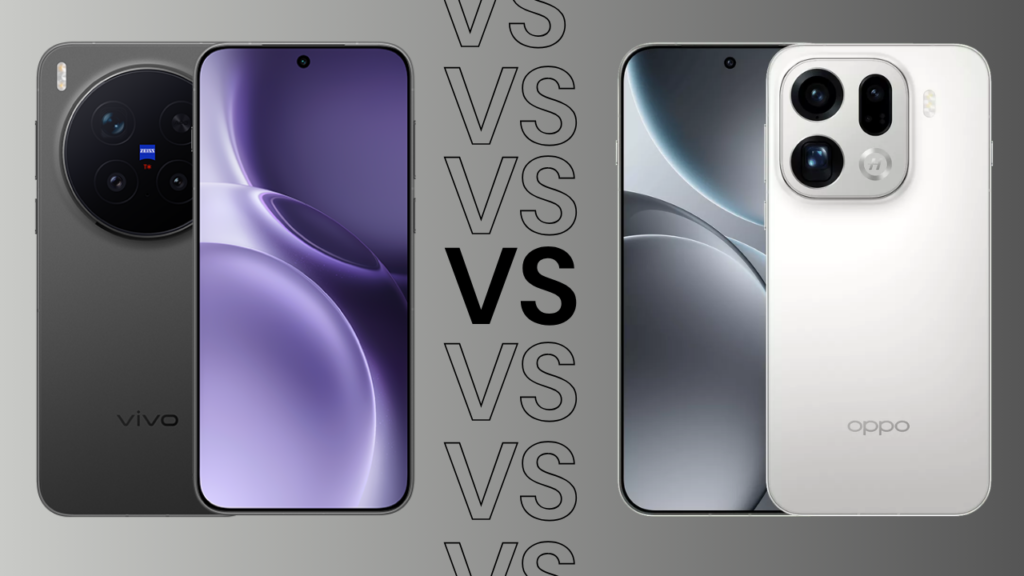
I’ve been carrying both of these phones around for over 100 days. Not borrowing them for a weekend review, not running a quick spec comparison, actually living with them, switching between them, handing them to colleagues, and paying attention to what annoyed me and what impressed me over time.
And here’s the honest thing about this comparison: these two phones are genuinely close. On paper, the specs overlap in a way that makes picking one sound almost arbitrary. But 100 days of real use has a way of revealing differences that a spec sheet just can’t show.
Let me walk you through what I found.
Camera: The Category That Matters Most for These Phones
Nobody buys a Vivo or Oppo pro flagship for the processor benchmark scores. They buy it for the camera. So this is where the comparison actually starts.
Both phones use a large 1/1.28-inch main sensor, and the level of detail retention in good light is genuinely similar between them. But the moment you start digging into how each phone processes that data, the differences show up clearly.
Vivo’s processing is cleaner. Less sharpening, less added contrast, more natural. In bright outdoor shots, that translates to better highlight control when a scene has a bright sky and a darker foreground, Vivo handles that transition more gracefully. Oppo tends to push the highlights a touch too far, and occasionally you get a sky that looks slightly blown out when Vivo would have held the detail better.
Low light follows the same pattern. Pull up a 100% crop from both phones on a dimly lit scene and Vivo pulls more visible detail. The HDR algorithm is stronger, shadow noise is more controlled. Oppo has definitely improved with software updates during the time I’ve been using it, but it still hasn’t closed the gap in these scenarios.
Color reproduction is another meaningful difference. Vivo in its Zeiss Natural mode delivers neutral, balanced tones the kind that look like what your eyes actually saw. Oppo leans slightly more saturated, which looks punchy in a feed but isn’t always accurate.
Here’s where it gets interesting, though: for skin tones specifically, Oppo’s Master Mode is noticeably better. More accurate, more lifelike. But this matters you have to know to use Master Mode. The default skin tone tuning in Oppo’s camera app is not great. Vivo’s default is more consistent even without shooting in a specific mode.
Portraits favor Oppo slightly. Edge detection is a bit cleaner, bokeh falloff looks more natural. Vivo’s edge detection is still excellent and you get those Zeiss filter options, but on pure technical accuracy for portrait shots, Oppo edges ahead.
Selfies, though? Vivo wins easily. More detail in daylight, stronger low light, more reliable HDR, and portrait selfies that just look cleaner. Oppo selfies are fine but inconsistent in a way that shows up over extended use.
Zoom is a split verdict. Up to around 3x, Vivo looks more balanced and natural. Through mid-range zoom 3.5x to roughly 25x Vivo generally holds the edge. Beyond 30x, Oppo’s AI tuning takes over and produces better results at those extreme ranges. Oppo’s 120x versus Vivo’s 100x max at those levels, Oppo is better. Everything below 30x? I’d go to Vivo.
Ultra-wide is basically a tie. Both have excellent sensors and I genuinely couldn’t pick a consistent winner there. Macro goes to Vivo.
For video, the difference is in philosophy. Vivo is about reliability, great stabilization, accurate colors, consistent exposure whether you’re switching lenses or scenarios. It’s a point-and-shoot experience that just works. Oppo is built for creators 4K at 120fps on both the main and telephoto cameras, Dolby Vision recording, and log video support. If you’re making content professionally, Oppo gives you the tools. If you just want your videos to look good without thinking about it, Vivo is more satisfying day to day.
Camera verdict: Vivo wins on consistency. Oppo wins on versatility and extreme zoom.
Performance: Similar on the Surface, Different in Practice
The chipsets in both phones are essentially matched on paper, and in most everyday tasks scrolling, app switching, browsing you’d never feel a meaningful difference. But benchmarking revealed some nuances.
GPU-heavy tests showed Oppo pulling ahead. 3DMark Solar Bay and Steel Nomad Light both favored the Find X9 Pro, suggesting more aggressive performance tuning in the graphics department. For gaming specifically, this translates into real differences on demanding titles. In Ark Knight Enfields, Oppo had a noticeably better average framerate and ran cooler at the same time. Vivo showed more dips under heavy GPU load.
In the CPU throttling test, both phones dropped to around the mid-60% stability range expected behavior for this class of chipset in sustained loads. GPU stability under extended load slightly favored Vivo, but Oppo’s raw performance before throttling kicks in is stronger.
The temperature story is interesting. Modern Snapdragon chips run warm, but neither phone gets uncomfortable. Oppo just manages demanding workloads more effectively before heat becomes a factor.
Performance verdict: Oppo wins, especially if gaming matters to you.
Design: Preference Over Facts
Design is subjective, and both these phones look premium. But there are objective differences worth noting.
Oppo has shifted to a square camera module on the Find X9 Pro, which reads as cleaner and more modern to most people I showed it to and to me personally. Vivo sticks with the large circular camera module it’s used for multiple generations. The circle is distinctive, but the Oppo design feels like a deliberate step forward.
In the hand, Vivo feels slightly more premium. The materials and weight distribution are excellent. The circular camera bump makes it feel thicker than it actually measures, but the balance is still good for single-handed use, probably a slight edge over Oppo here.
Physical buttons: Oppo has a better setup. The Snap Key for AI functions and the camera control button add genuine utility. Vivo’s action button is small and feels like an afterthought. Having used both for months, I reached for those Oppo hardware controls more often than I expected to.
Durability held up on both. IP69 ratings, cases in the box, pre-applied screen protectors. After 100 days with both, there are minor scratches on both phones, and the Find X9 Pro developed a small dent on its aluminum frame after a drop of soft metal, that’s expected. Neither phone felt fragile.
Display: Nearly Matched With One Clear Differentiator
Large AMOLED panels with LTPO technology on both 1Hz to 120Hz adaptive refresh, among the best displays you’ll find on any flagship phone right now.
In calibrated testing, the X300 Pro has slightly more accurate color skin tones that look more natural, tuning is more neutral. Oppo’s display is punchy, which looks great for content consumption.
Brightness is essentially matched for outdoor use and HDR playback. Both support Netflix and YouTube HDR content.
The one clear win for Oppo: low-brightness performance. The Find X9 Pro can go down to 1 nit, which Vivo can’t match, and it has a higher PWM dimming rating. If you use your phone in a dark room at low brightness, Oppo is genuinely more comfortable and less likely to cause eye strain over time.
Haptics are excellent on both, with Oppo feeling slightly tighter. Speakers: Vivo gets louder, Oppo sounds richer. Depends what you value.
Battery: Oppo Wins Clearly
This category isn’t close. Oppo’s 7,500mAh battery is the best battery experience I’ve had on a flagship phone. Heavy usage gets 9 to 10 hours of screen-on time. Moderate usage pushes to 12 hours. Day and a half of real use is consistently achievable.
The X300 Pro has good battery life. 7 to 8 hours of screen-on time is solid. But it doesn’t compete with Oppo here.
Vivo charges slightly faster from a cable, which is nice. Oppo has a slight edge in wireless charging speed, though the proprietary wireless charger is a separate purchase and can be hard to find.
Software: Color OS is Simply Better
After 100 days with both operating systems, Color OS is more refined, more feature-rich, and smoother than Origin OS. The difference in overall system smoothness is noticeable. Customization options are deeper on Color OS, and the overall experience feels more polished.
Origin OS has useful features Origin Island, Office Kit, a solid set of AI tools but it doesn’t feel as mature. Vivo has been pushing updates consistently (four minor updates during the test period versus three for Oppo), but the underlying experience still has some rough edges.
One Oppo-specific feature worth highlighting: Oriong. It lets you purchase an eSIM directly from the phone while traveling, and pause the eSIM when you’re not using it so you don’t burn through data. Small feature, but genuinely useful if you travel.
Final Verdict (Oppo Find X9 Pro vs Vivo X300 Pro)
After 100 days, my daily driver became the Oppo Find X9 Pro. Vivo X300 Pro is a genuinely excellent phone. If you handed it to someone and asked them to live with it, they’d be happy. The camera consistency is real, the Zeiss processing is good, and the hardware feel is premium.
But Oppo wins on performance, battery life, software, and versatility and that combination adds up to a more complete flagship experience over time.
If consistent camera results and clean processing matter most to you, and you shoot more photos than video, Vivo is defensible. If you want a phone that handles everything well including demanding gaming, marathon battery days, and a polished software experience Oppo Find X9 Pro is the pick.
The gap between them isn’t huge. But it’s consistent, and consistent gaps over 100 days start to feel significant.
Discover Also iPhone 17 vs Huawei Pura 90 I Tested Both and Here’s the Honest Truth

M Adnan Akram is the founder and lead writer at Phoonomo, covering mobile technology with a primary focus on Apple and the broader smartphone industry, alongside emerging developments in AI. He follows product launches, spec leaks, and industry trends closely to keep readers informed with timely updates.
Discover more from Phoonomo
Subscribe to get the latest posts sent to your email.