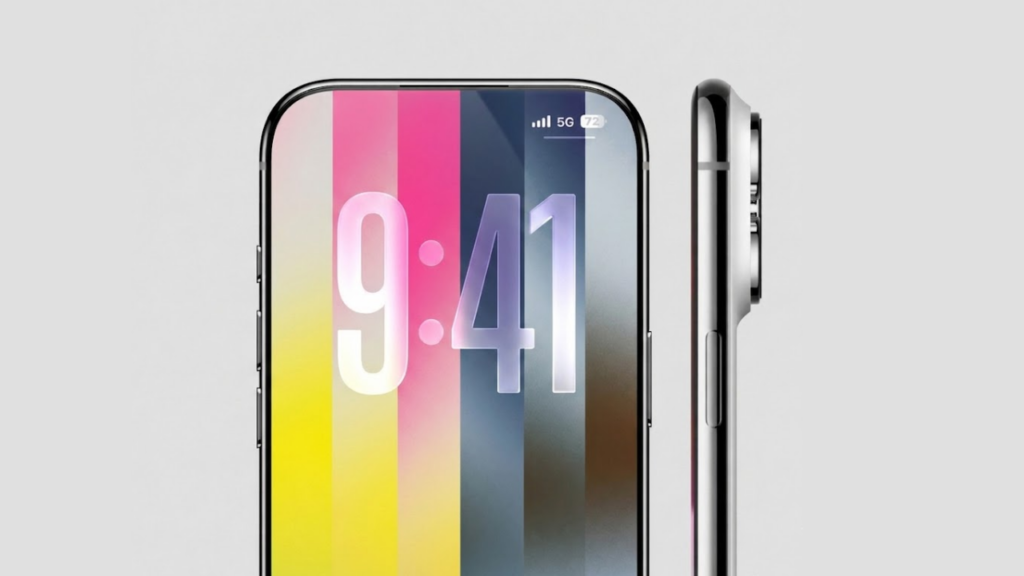
Apple’s regular, bar-shaped iPhone Pro and Pro Max could get a major display upgrade in the second half of 2029, according to South Korean display research firm UBI Research. The claim centers on CoE (Color Filter on Encapsulation) OLED, a panel design that ditches the traditional polarizer layer in favor of a color filter placed directly on the OLED’s encapsulation. Apple hasn’t confirmed any of this; it’s UBI Research’s own forecast, based on how display supply chains typically evolve.
The polarizer’s job is cutting down glare from ambient light, but it also eats up some of the brightness the OLED panel produces. Removing it means more light gets through, which can translate into lower power draw at the same brightness, or higher brightness at the same power, along with a thinner panel stack.
| Conventional OLED | CoE OLED | |
| Polarizer | Present | Removed |
| Light transmission | Partially absorbed by polarizer | More efficient |
| Panel thickness | Thicker (extra layer) | Thinner |
| Power at same brightness | Higher | Potentially lower |
| Maturity | Established | Still specialized |
UBI Research’s reasoning for the 2029 timeline is that Apple typically tests display technology on its foldable before bringing it to the much higher-volume Pro lineup, the same way Apple’s Pro-series OLED panels have steadily improved generation over generation. CoE has already been commercialized in foldables Samsung Display used its own version, branded Eco² OLED, on the Galaxy Z Fold3 back in 2021. Apple’s newly launched iPhone Duo is expected to use CoE too, though that hasn’t been independently confirmed through a teardown yet.
On the supply side, UBI Research expects Samsung Display and LG Display to hold an early advantage, given their existing polarizer-free OLED experience and their current role supplying Apple’s OLED panels. BOE isn’t ruled out, but the firm says Apple’s bar for color uniformity, outdoor visibility, and manufacturing yield is steep, so BOE would likely need more time to qualify.
The bigger challenge with CoE isn’t just removing the polarizer, it’s replacing everything that layer used to handle, from glare control to color accuracy, using a combination of color filters, low-reflection coatings, and optical compensation. That complexity is likely why UBI Research expects Apple to keep this confined to the foldable for now before scaling it up to the Pro lineup years down the line.
Source: UBI Research

M Adnan Akram is the founder and lead writer at Phoonomo, covering mobile technology with a primary focus on Apple and the broader smartphone industry, alongside emerging developments in AI. He follows product launches, spec leaks, and industry trends closely to keep readers informed with timely updates.
Discover more from Phoonomo
Subscribe to get the latest posts sent to your email.