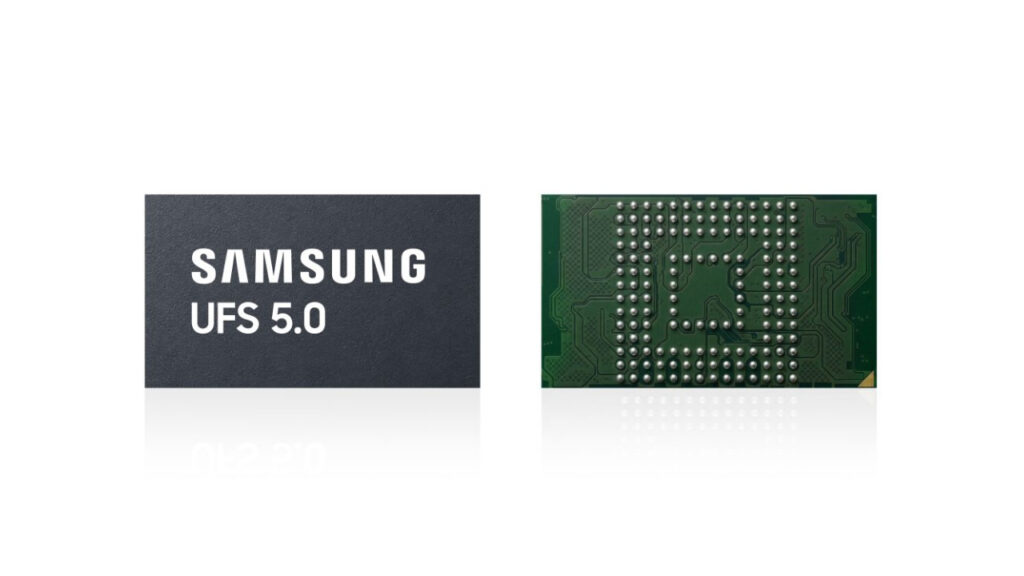
Samsung just announced something that doesn’t make headlines the way a new phone does, but matters just as much to how your next smartphone actually performs. The company has unveiled the industry’s first UFS 5.0 storage solution, and it’s built specifically with on-device AI in mind, not speed benchmarks, not marketing numbers, but the actual workloads that modern AI smartphones are struggling to handle fast enough.
The raw numbers are worth sitting with for a moment. UFS 5.0 delivers read speeds of up to 10.8 GB/s and write speeds of up to 9.5 GB/s. That’s more than twice the throughput of UFS 4.1, which is what you’ll find inside most of today’s flagship phones including the Galaxy S25 series. The architecture behind that jump involves JEDEC’s UFS 5.0 standard running on M-PHY 6.0 and UniPro 3.0 essentially a complete overhaul of the pipeline that moves data between storage and the processor.
Speed alone isn’t the story though. Samsung is claiming 40 percent better power efficiency compared to UFS 4.1, which is significant because AI processing is one of the heaviest battery drains on any modern phone. Running large language models locally, processing AI photo edits, handling real-time video analysis all of that pulls hard on storage and power simultaneously. UFS 5.0 is designed to do more while drawing less. The physical package is also about 16.7 percent smaller than UFS 4.1, which gives phone makers meaningful extra room for larger batteries or improved cooling systems.
Capacity goes up to 1TB, which pairs naturally with the kind of on-device AI model storage that’s coming down the road.
The realistic timeline here is Q4 2026 for mass production, with first devices likely arriving in 2027 flagship smartphones. Reports suggest the Galaxy S27 Ultra is a strong candidate, though Samsung hasn’t officially confirmed any specific device.
One honest caveat worth keeping in mind: storage speed improvements don’t always translate dramatically to everyday use. The CPU, GPU, and thermal management still set the ceiling. But for AI-specific workloads, faster storage with lower latency genuinely moves the needle. When UFS 5.0 phones arrive, the benchmark that matters is how quickly your phone handles AI tasks without heating up. That’s the test worth watching.

M Adnan Akram is the founder and lead writer at Phoonomo, covering mobile technology with a primary focus on Apple and the broader smartphone industry, alongside emerging developments in AI. He follows product launches, spec leaks, and industry trends closely to keep readers informed with timely updates.
Discover more from Phoonomo
Subscribe to get the latest posts sent to your email.