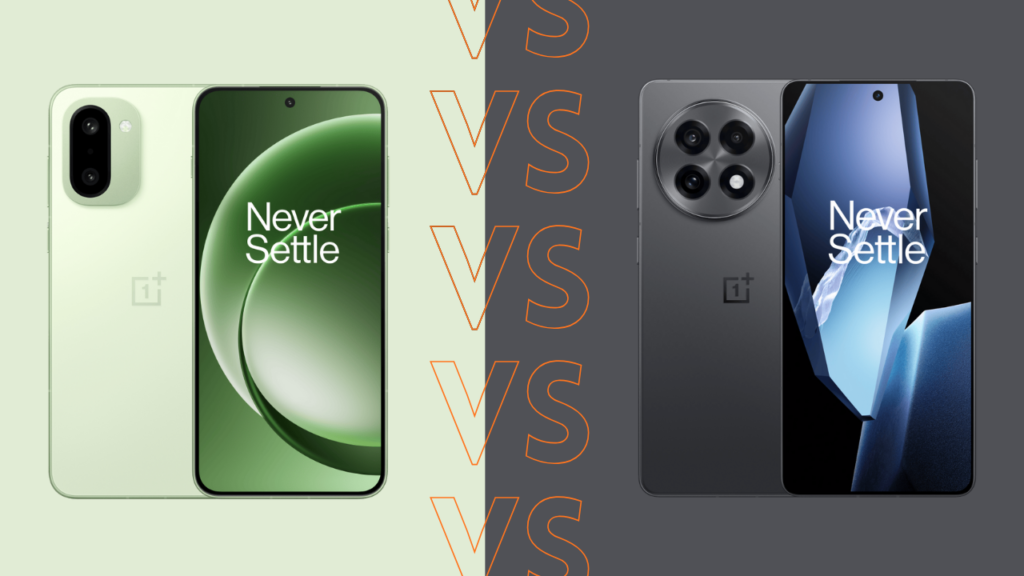
Last year’s OnePlus 13R was a return to form for the company and most of us appreciated the phone, if not all of us. But for the new OnePlus 15R, considering that smartphone prices are going up, can it continue the trend of being the best flagship killer out there in the market? That’s exactly what we’re going to find out in this review where I’ve reviewed the OnePlus 15R in detail and compared it to the OnePlus 13R as well. So, I think all your questions should be answered. So, stay tuned till the end. If you’re here for the first time.
Design
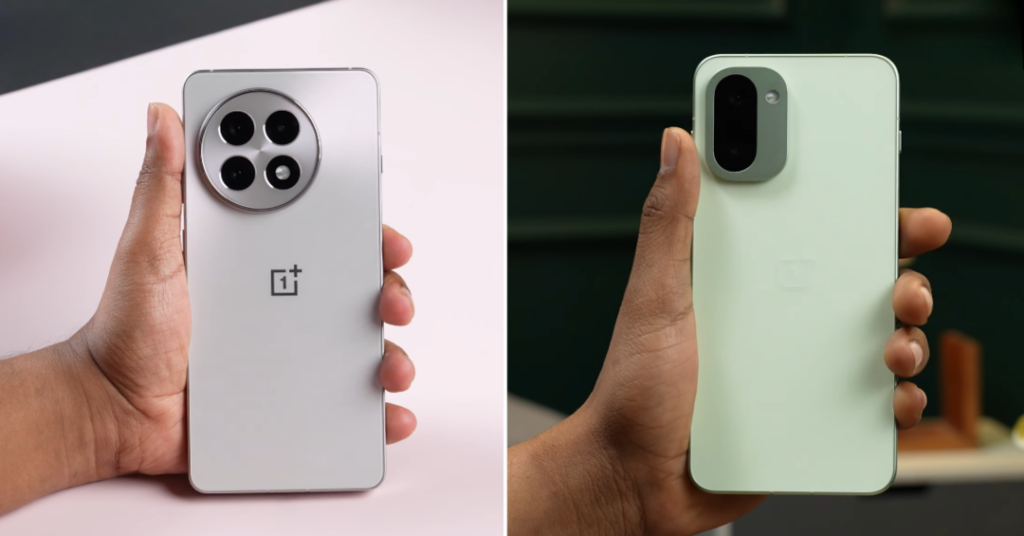
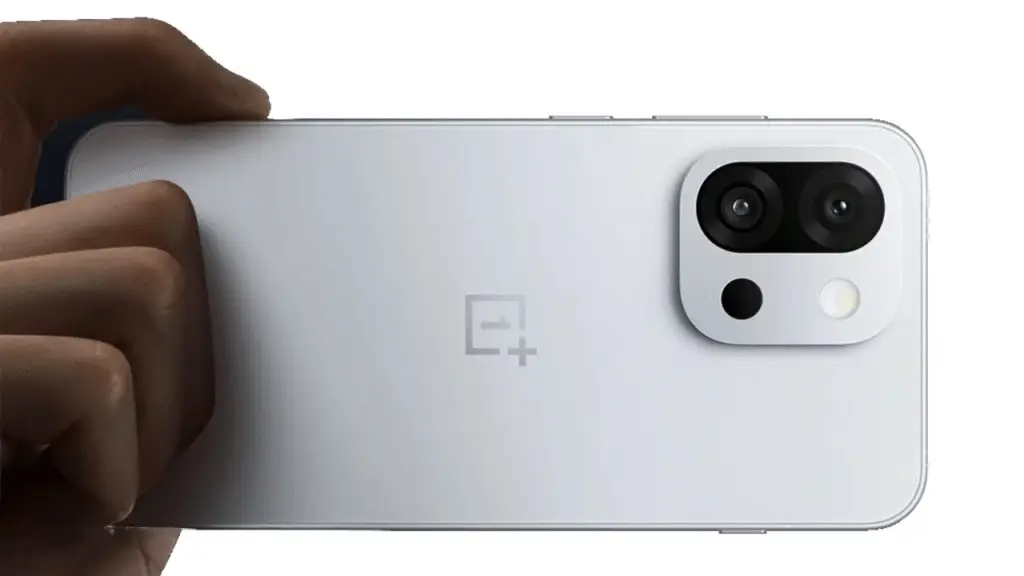
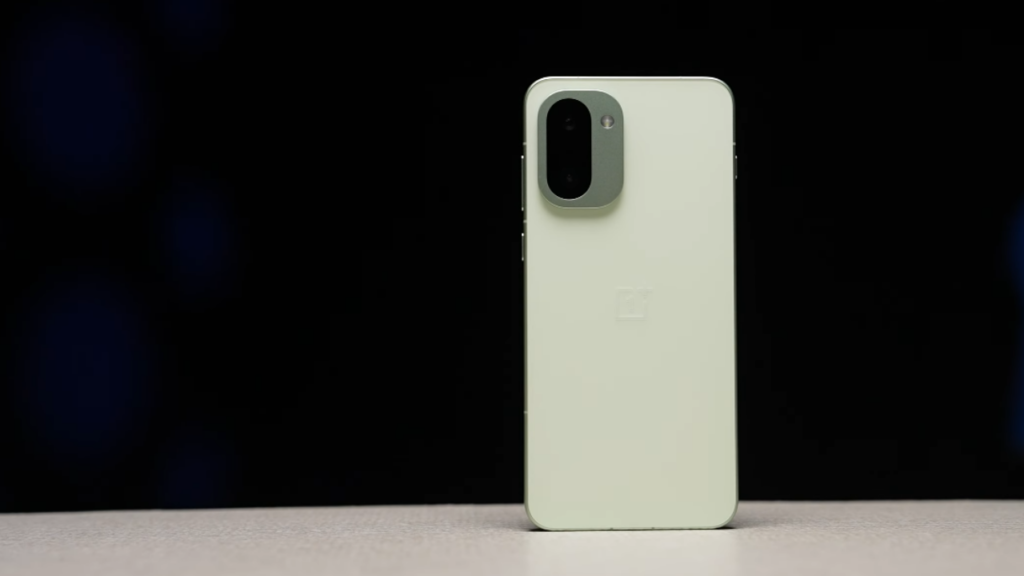
Now, the first time I laid my eyes on the OnePlus 15R, I could tell that, you know, OnePlus has carried forward the same, you know, design language from the OnePlus 15. You get a very similar
camera module. Now, it’s slightly thinner, so it’s a squirangle. And the reason for it to be slimmer is because it obviously doesn’t have the third camera. But I would have liked for the OnePlus to have actually saved a little more space and just made this into like a camera island, but then it would look like an iPhone. So I think this is like a distinctive character.
Now the 13R of course had the circular camera module. Now which one do you prefer? Let me know in the comments.
In Hand Feel
The one thing that you distinctively also feel when you hold both the phones in the hand is the 15R feels heavier compared to the 13R. That’s primarily because it’s got a much larger battery inside. I’ll come to the battery debate, but it is also packing a larger display and therefore it’s also taller and slightly wider as well.
But the good thing is that it’s not too much thicker compared to the 13R. And more importantly, the edges are more rounded. And you know, compared to the 13R, they feel more comfortable when you’re holding the phone.
Color Options
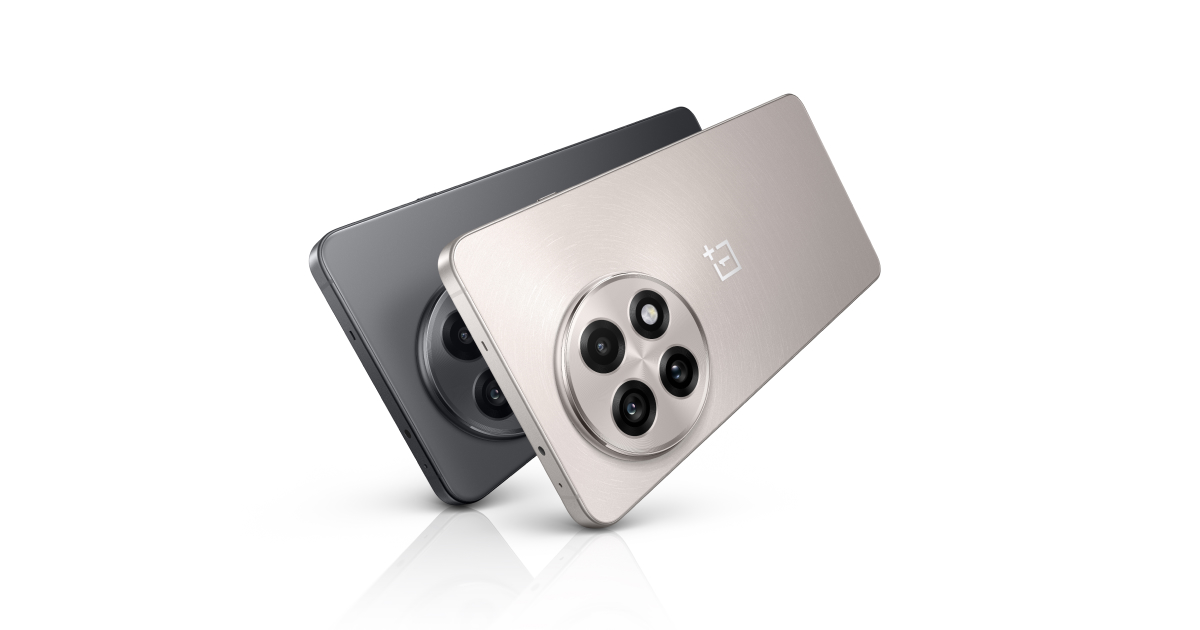

Now, the 15R comes in three finishes. You have charcoal black with a glass back. You’ve got the electric violet with a fiberglass back and the mint breeze again with a glass back. I do like the mint breeze color. By the way, the 13r in comparison had the Nebula Neer with a satin glass back and a trail with a textured finish on the rear.
Durability
Another thing that OnePlus has improved in the design of the 15R is the fact that it now has better IP rating support. So you get support for IP66, 68, 69 and 69K whereas the 13R only had IP65. As for the display protection on the front, both the phones have Cornol Glass 7i. So even if you do, nothing will happen to it.
Ports, Buttons, and the New Plus Key
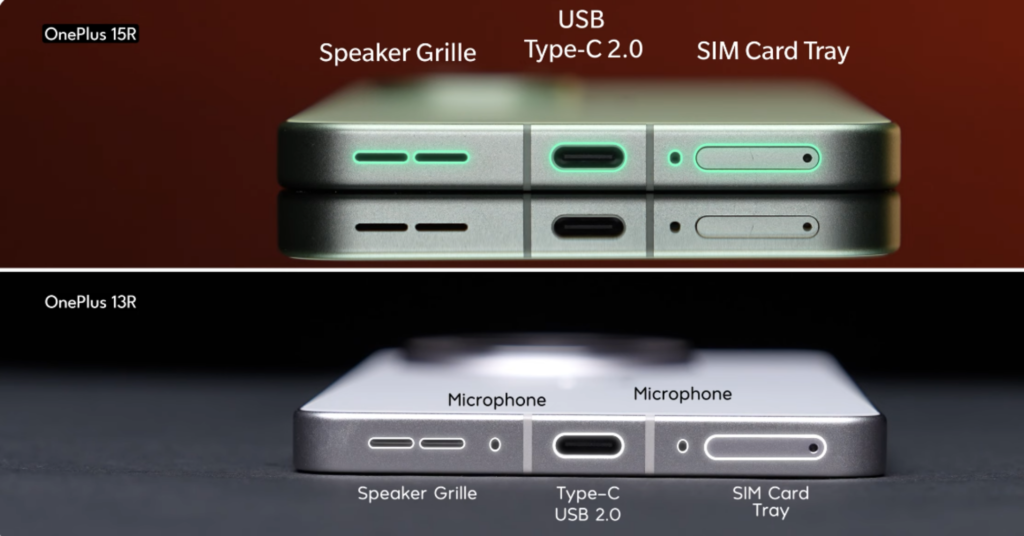
Now as for the buttons and ports, you do get the type-C 2.0 port at the bottom. Yes, you do not get Type-C 3.1. So that’s something that’s a bit of a miss. You get the power button, the volume rocker, all of that is there. You get the speakers, you get a SIM card tray with dual nano SIM card support and an infrared blaster.
But one distinctive change is that the 15r now comes with the plus key instead of the alert slider because that’s a direction that OnePlus has taken with their phones this year. The plus key by default when you press it, it opens mind space or invokes the voice record function with plus mind. But you know if you want you can actually also have any other function mapped to it.
Display
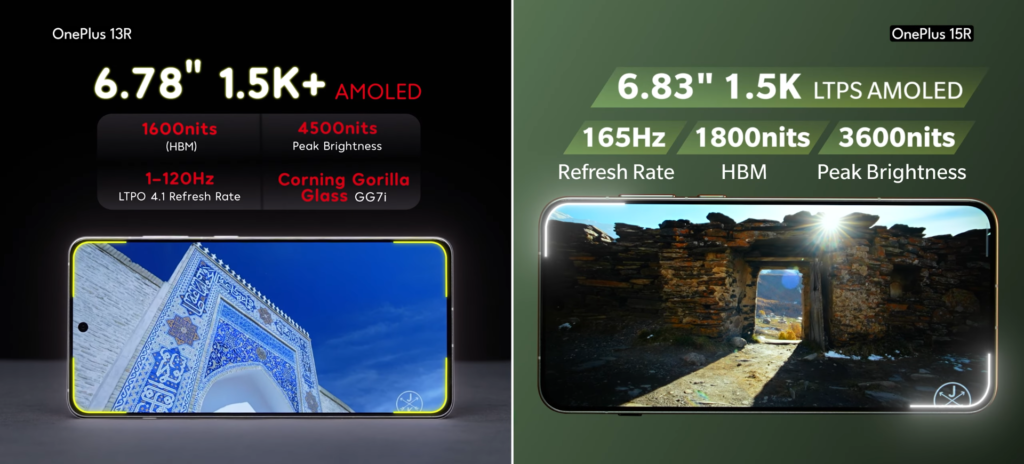
Displays on both the 15R and the 13R. There are certain key differences that you guys need to know. Firstly is that the 15R has a slightly larger sized panel compared to the 13R but it’s slightly different in terms of absolute specs primarily because you get a slightly larger display on the 15R. Now with the 15R what you get is 165 Hz refresh rate at the top end in certain supported games and apps. But with the 13R it can reach up to 120 Hz. In fact in system UI basically when you’re using the system itself the 15R also runs at 120 Hz. But the key difference here to note is that the 13R had an LTPO panel whereas the 15R has NTPS technology.
HDR Support and Brightness
As for the HDR support, you get all of the formats available on both including Dolby Vision. So you do get HDR video playback on YouTube and Dolby Vision video playback on Netflix. Now both the displays are almost equally bright outdoors. We couldn’t tell the difference between the two really. But when we watched HDR content side by side, especially that interstellar black hole scene, we noticed that the 13R, especially at the highest, you know, brightness peak points, gets slightly brighter than the 15R, not too much of a difference until you check them side by side. Also, interestingly, the OnePlus 13R has a video color boost toggle. It tried to enhance the SDR content to look closer to HDR. Now, this feature, while it’s not something that I really care about, but a lot of people did, but it’s not available on the 15R if you cared about it. Now we compared the color reproduction on both the displays and it is slightly different on both in that actually the 15R does a better job than the 13R in terms of being neutral in terms of color accuracy.
Pro Color Mode
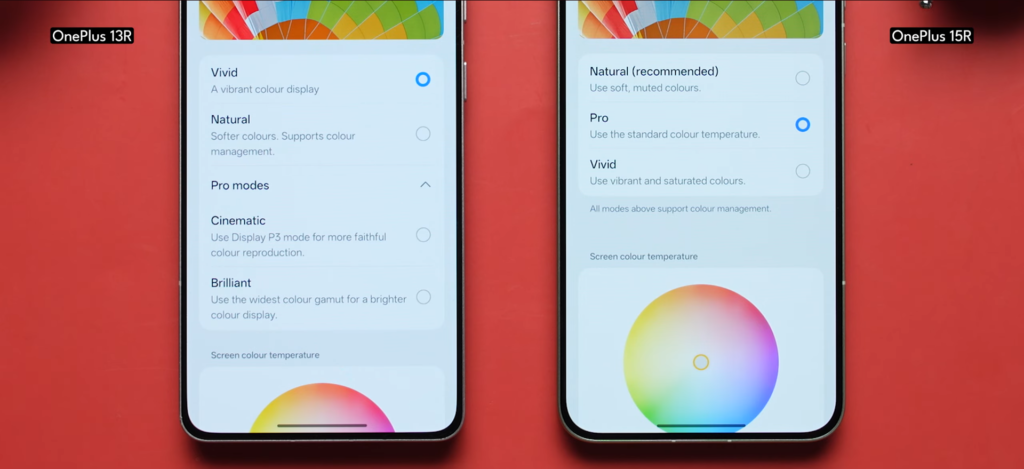
Now both these phones do have the Pro color mode option. Interestingly the 15 didn’t come with the Pro color mode option but the 15R has it and in the 13R actually the procolor mode also has been further broken down into two separate options which is basically cinematic and brilliant. Now,
we checked the cinematic Pro color mode on the 13R compared to the 15, you know, regular Pro color mode. And here we notice that the reds and the greens are slightly deeper on the 13R compared to
the 15R, which actually does a better job. In fact, the 15R renders skin tones better than the 13R as well. So, color reproduction wise, I think that OnePlus has done a better job with the 15R.
Fingerprint Scanner and Haptics
Now, also part of the display is the fingerprint scanner. And here, OnePlus has made an upgrade to the 15R where you get an ultrasonic display fingerprint scanner, whereas the 13R had an optical one, which actually makes it better on the 15R. Haptic feedback wise, I do not see any difference in the kind of tuning that you get on both. Both are almost equally good.
Now, with respect to audio performance, you do get LHDC and LDAC support on both the phones, but the stereo speaker quality is slightly louder and richer on the 15R compared to the 13R. So overall, if you look at it, when you compare the display and the multimedia experience, I feel like despite not having LTPO technology, OnePlus has done a good job with the 15R and has given some upgrades that make sense. For example, the fact that the color tuning is better now. You also do get an ultrasonic in display fingerprint scanner and the speaker quality is also superior.
Performance
Let’s talk about the performance. And performance is one of the most exciting parts of this comparison because the 15R is the first phone that we’ve tested and possibly the first phone in the world to also come with the Snapdragon 8 Gen 5 processor. Now remember how the OnePlus 13R had two variants, 12, 256GB and 16, 512GB variants with LPDDR 5X RAM type and UFS 4.0 storage. Now the 15R doesn’t have the 16 GB RAM variant. You have 12, 256 and 12, 512GB variants with LPDDR 5X ultra RAM type and UFS 4.1 storage. Now that’s obviously because the 16 GB RAM variant is going to be more expensive. OnePlus didn’t introduce that one.
Benchmark
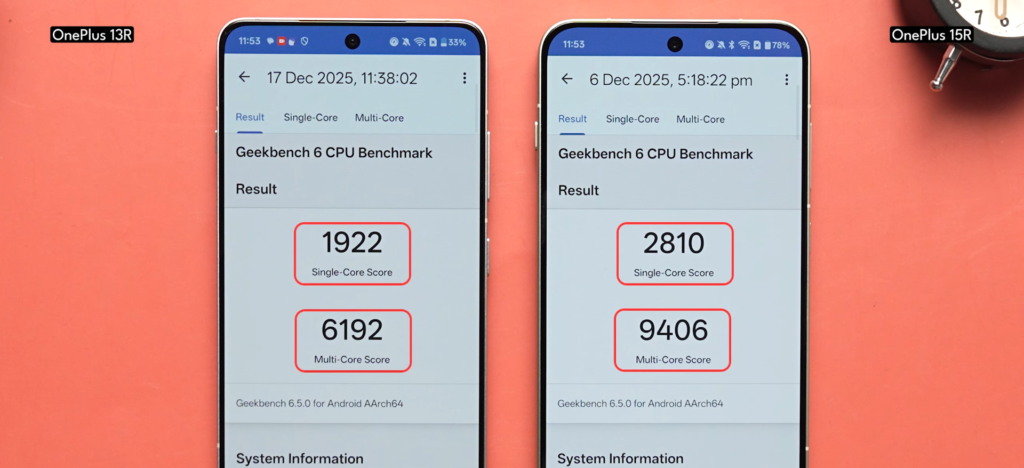
Now let’s take a look at the benchmarks. And obviously the 15R performs better than the 13R in almost every single aspect out there. So, you get a better score, that’s for sure. You also do get better single core and multi-core scores in Geekbench 6. And if you look at the pure GPU scores in the Solar Bay rate tracing test and the Steel Nomad Light test, you will notice that the 15R edges ahead of the 13R. It’s not a huge difference in the GPU performance numbers, but yes, there is still a difference. But what’s more heartening to see is the fact that the stability on the 15R is better than the 13R.
You get far better CPU stability. In a CPU throttle test where we engage 40 threads for 30 minutes, the 15R remains far more stable over longer works. In fact, even in our 3D Mark Wildlife Extreme stress test, the GPU stability was better despite offering higher best loop scores. It was to be expected that the Agent 5 is going to perform better than the Agent 3 obviously. But more importantly, OnePlus has managed to tune it really well also thanks to the fact that the thermal efficiency is better too.
Gaming
Now, I’ll talk about that in a bit, but uh let’s take a look at the gaming performance now. Now we run Genchin Impact and Wuthering Waves both on the OnePlus 13R and the 15R. Now both these games are not stressing most uh you know modern GPUs out there. So what we noticed is that the average FPS is largely similar to each other. But the 15R’s advantage is the fact that you can run near native 120 fps you know gameplay with Genshin Impact thanks to the fact that you get the hyper frame rate option which was also something that we noticed with the OnePlus 15. But obviously compared to the OnePlus 15 you do not get 119 FPS average FPS. You get somewhere between 110 to 112. Now, obviously the performance of the 120 fps Genshin Impact gameplay is not at the level of what we achieved with the OnePlus 15 with the Snapdragon 8 Gen 5.

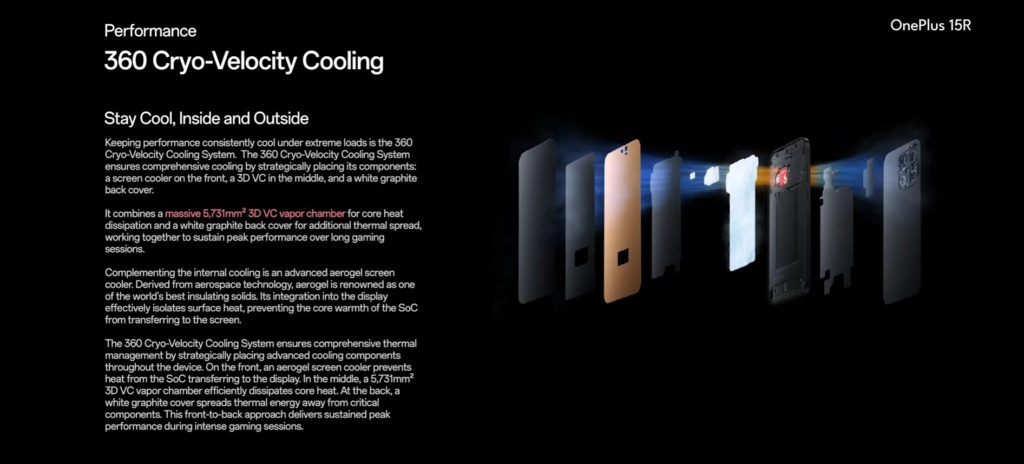
But here’s another advantage for gamers especially out there because a lot of gamers are going to consider this phone. The 15R supports 165 FPS gameplay in a lot of games now. You also do get an improved cooling solution inside the OnePlus 15R which is very similar to the OnePlus 15 which is basically a 3D cryo velocity cooling chamber that is there inside the phone. Now, with that, it manages thermals much better. It doesn’t get too hot. It’s consistently under 43° even if you’re pushing the gaming uh, you know, performance.
RAM Management
For sustained workloads, the 15R should be able to do a better job than the 13R. Not that the 13R was bad, but the 15R will have better longevity. In fact, one thing we noticed is that the RAM management is superior to on the 15R. Apps stay alive in the background for longer. So, if you want a current phone for even longer usage, for long-term usage, the performance headroom that you have and the tuning that OnePlus has done with the Snapdragon 8 Gen 5 should definitely come in handy. So, say for example, if the OnePlus 13R has 3 years more life, you know, without any performance drops, then the OnePlus 15R definitely has 5 years more life without any performance drops.
Battery & Connectivity
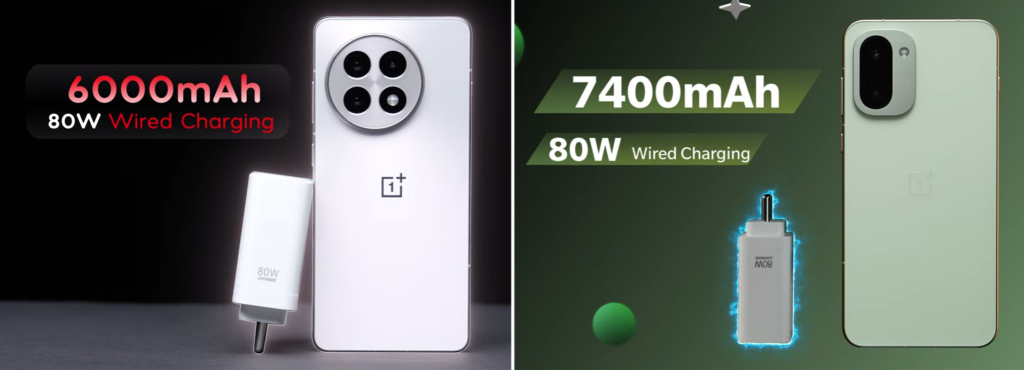
Battery is another area where the OnePlus 15R steps up by quite a bit. The 13R had a 6,000 mAh battery. The 15R has a 7,400 mAh battery. And we’re easily getting over 12 hours of screen on time with the 15R. Obviously, the 13R cannot match the performance of the 15R in terms of battery life. In fact, once we even got over 15 hours of screen on time with the 15R. Battery charging speeds are largely similar. You get 80 watt charging speed with the charger inside the box. And of course, there’s still no wireless charging. Now, with respect to the networking abilities, now both the phones do come with Wi-Fi 7 and NFC support. And you have a bunch of 5G bands at your disposal. But one advantage on the OnePlus 15R is that you get the latest Bluetooth 6.0 standard as opposed to Bluetooth 5.4 on the 13R.
Camera
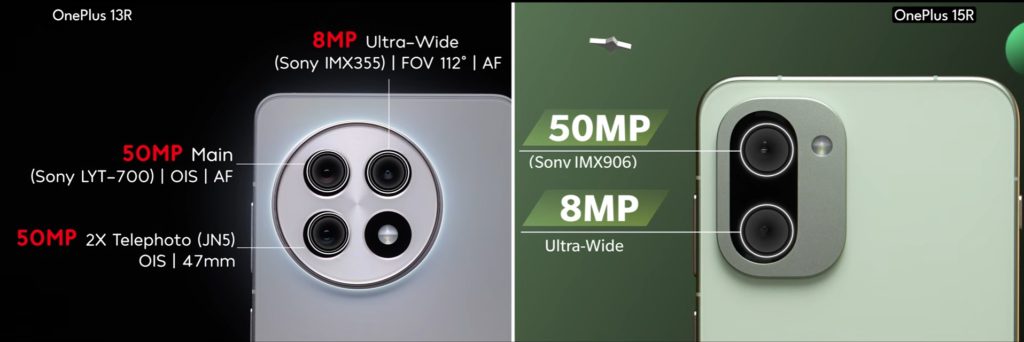
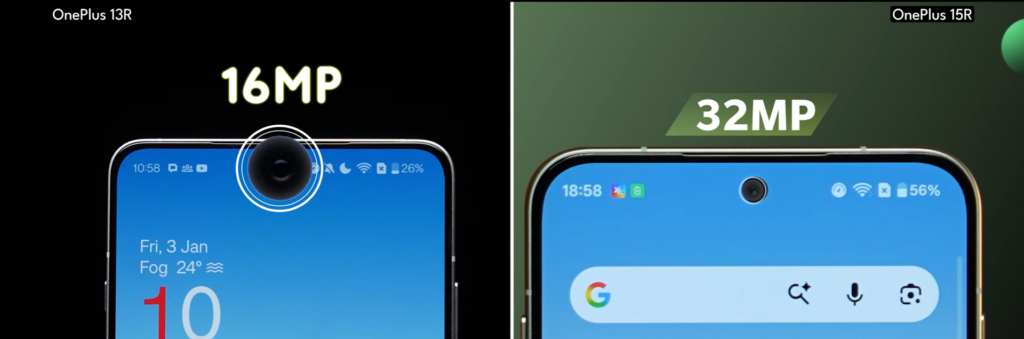
The camera specs are where things get really interesting. I’m showing you the comparison specs on the screen right now. And you will notice that the OnePlus 15R doesn’t have the 2x telephoto that you got with the 13R, but the 15R has a better quality selfie camera, which is a 32 megapixel selfie camera with autofocus. Now, but here’s an interesting thing to note is that the 15R actually uses the new Detail Max engine that we saw in action in the OnePlus 15.
DetailMax Engine
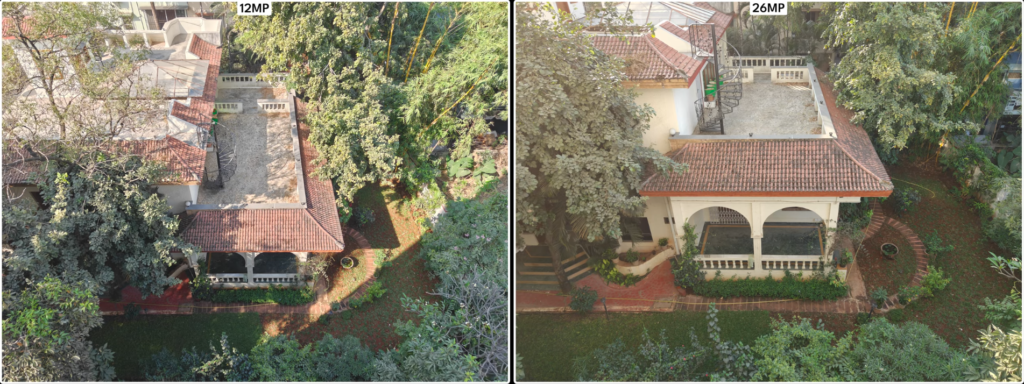
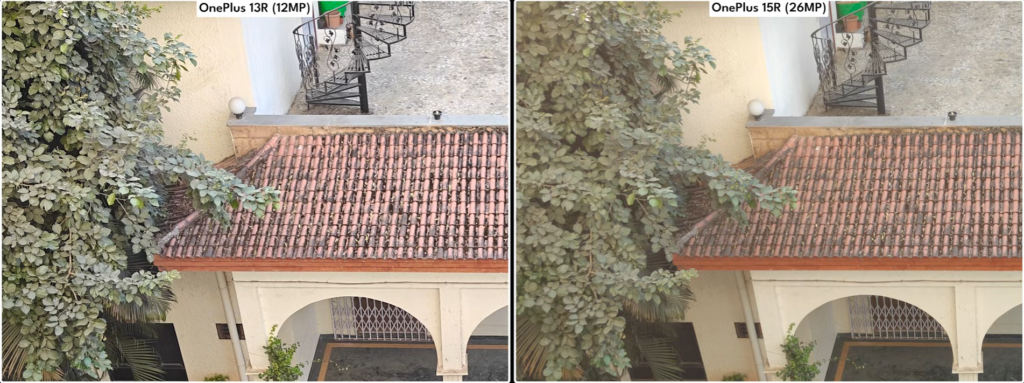
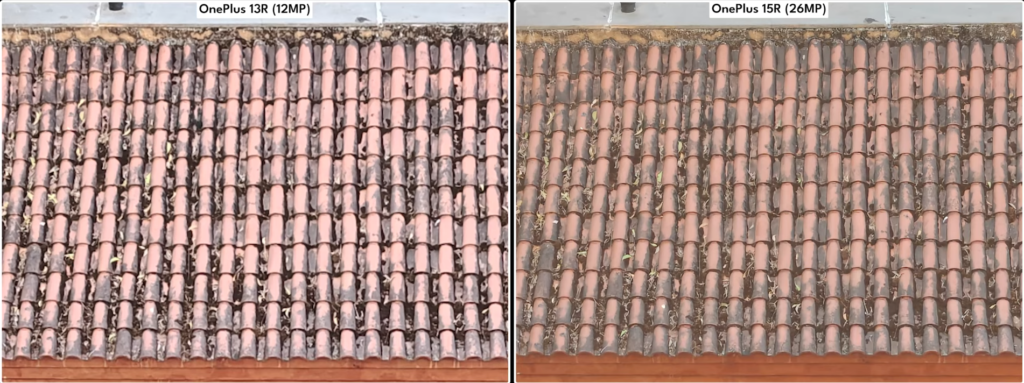
Now, the 13R didn’t have Hasselblood support like the 13 did and it doesn’t even get the benefit of the DetailMax engine. So, maybe tuning could be better on the 15. Well, let’s see. Let’s take a look at the pictures. So, with the new DetailMax engine, the 15R can output 26 megapixel shots. Now, for this, you need to go into settings and switch on the high-res modes. Keep that in mind. And it also takes a look at the amount of light available, the kind of aperture that it is using to figure out if it should shoot a 26 megapixel shot or a 12 megapixel shot, it shoots this automatically. But when you compare a 26 megapixel shot on the 15R to a 12 megapixel output on the 13R, you can see that there are more details on offer. However, sometimes I felt like the 15R’s details at 100% crop look slightly softer compared to what we saw on the OnePlus 15.
HDR and Skin Tones
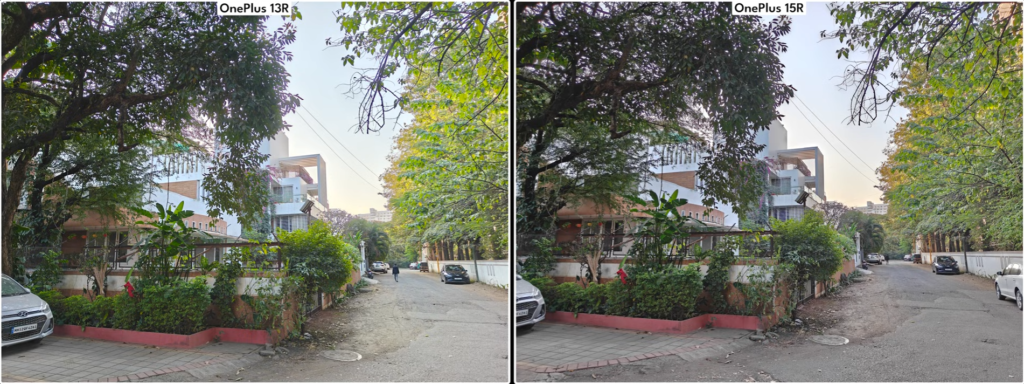
The one area where the Detail Max engine comes in really handy is in HDR tuning. And the 15R’s HDR performance is better than the 13Rs. In some pictures you’ll notice that the highlight control is slightly better on the 15R. And even the gradient of the sky looks much clearer. In fact, even the dynamics at play here along with the shadows looks a little more a little better in the HDR sample on the 15R compared to the 13R. Now, another advantage with the DetailMax engine is that when you’re shooting people against the light, there used to be this problem of like a glowing face, which was not too much of an issue with the 13R, but that’s been further reduced with the 15R, and it’s much better now.
Skin tones have also improved on the 15R. The 13R pushes more reds than I’d prefer. It’s not like the 15R is closest to neutral skin tones, but it’s better than the 13R, at least when you check them side by side. Now, in portrait shots, however, it’s a bit of a mixed bag out here because what you get are options to shoot at 1x and 2x on the 13R. But with, you know, the 15R, you can actually shoot 35 mm or 1.5x shots as well.
Now, when we compared the portrait samples, we noticed that the edge detection was actually better on the 13R, and there were slightly more details as well. However, the skin tones again are better on the 15R. Now, talking about that 8 megapixel ultra wide angle camera, it’s kind of average on both. It comes in handy once in a while, but you know, low light shots definitely take a hit.
Selfie Cameras
Now, considering that the selfie camera has been upgraded on the 15R, the selfies do look much better, especially when you take a look at daylight, the portraits, the HDR samples, and even the low light, thanks to the fact that now you do have autofocus. But yes, thanks to the dedicated 2x camera that you get with the 13R, zoom is definitely better. Whether it’s at 2x, 3x, 4x, 10x, or even 20x, the 13R captures more details both in daylight and in low light zoom shots.
Videos
Now, finally, 15R pulls back a win with video recording quality. Now you can shoot 4K 60 fps using the primary camera on both the phones. But now with the primary camera on the 15R, you can also shoot 4K 120 fps videos. The ultra both can shoot at 1080p 30 fps. Just by looking at those differences, you can tell that the primary camera has higher frame rate options and the selfie camera has better resolution on offer. And even otherwise, when you take a look at the quality of the footage itself, the stabilization is better, dynamic range is better, and the low light videos also look cleaner on the OnePlus 15R compared to the OnePlus 13R. In fact, even the sound recording on the 15R is better compared to the 13R. The advantage on the OnePlus 15R is the fact that you can record at 4K 30 fps as opposed to the 13R which records at 1080p 30 fps. This is definitely an upgrade. Now, the 13R has an advantage in zoom videos because it has a dedicated 2x camera.
But otherwise, I feel like the video recording capabilities of the 15R are better. And now that I’ve evaluated all the cameras, I can tell you with a fair bit of confidence that the DetailMax engine is doing a good job with the 15R despite the lack of that telephoto. Yes, you do not get the versatility of the 13R, but you do get a more refined camera experience with the 15R and upgrades that matter like for example the 32 megapixel selfie camera or better video recording quality.
Software
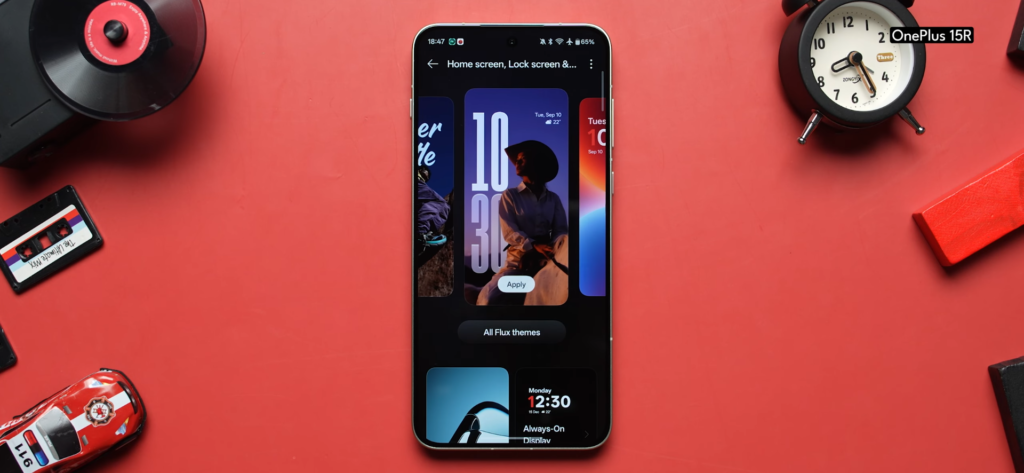
All right, now finally to talk about the software experience, it’s Oxygen OS 16 based on Android 16 and OnePlus is promising 4 plus 6 years of updates which is true for the 13R as well. With the 13R, you won’t get as long updates as the 15R, obviously, because the 15R is a newer phone, but largely the Oxygen OS 16 experience is going to be similar on both. So, basically, what you have are scalable icons and an improved control center design with more control.
Customization
You get more lock screen options in Flux 2.0. You get even better animations with parallel animations 2.0. You get minimal software bloat with a clean experience. You get a lot of AI features but currently of course that AI writer feature is not working because OnePlus is investigating an issue. And of course there’s plus mind with mind space and that’s a clear winner for anybody who actually likes using uh you know taking screenshots and keeping uh information and you know analyzing information and creating summaries and all of those things. It’s pretty cool and of course you do get Google Gemini and circle to search support as well with Gemini integration available for mind space too. So overall if you look at it the software experience is the best on both the phones. Seeing the prices of RAM going up means that smartphone prices are also going up.
Conclusion (Oneplus 15r vs Oneplus 13r)
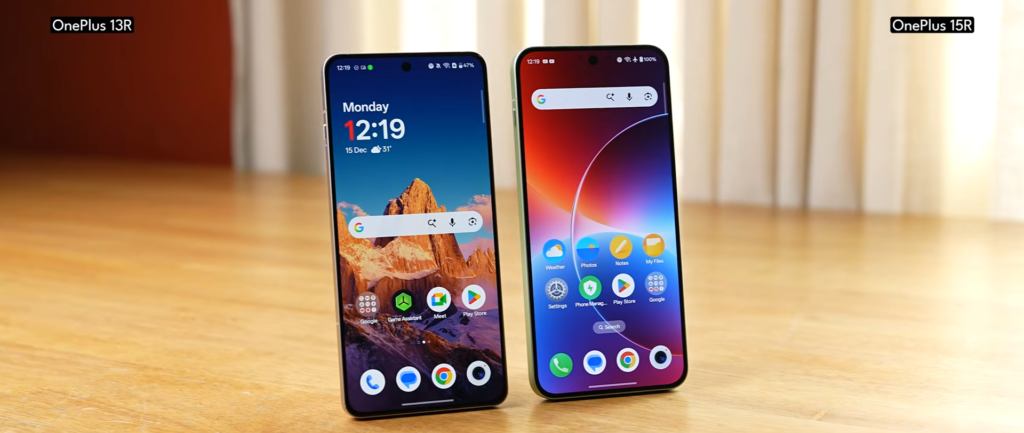
The point is for the extra price that OnePlus is asking for the 15R, do you get more? I feel like you actually do. And I do also feel that the 15R continues to be the great flagship killer experience that everyone wants from an R series OnePlus 4. Yes, when you compare the 15R to the 13R, there are two specific, you know, downgrades that everybody knows about.
One of them is the fact that you do not get the telephoto. And the second one is that it’s not an LTPO display, but in every other aspect, whether you look at the performance, it’s definitely better with the Snapdragon 8Gen 5. You also do get a better tuned color accuracy with the display. You also get a better speaker quality and an ultrasonic and display fingerprint scanner. Even when you look at the build, you do get IP69K rating now, which is IP69, IP69K in both. And with the DetailMax engine, you do get a refined camera experience, but most importantly, the video quality is superior compared to the 13R.
And finally, you also do get far better battery life on the OnePlus 15R compared to the 13R. So overall, if you look at it, I’d say that the 15R is a good upgrade over the 13R and OnePlus has done a good job with this phone. Do you guys also feel the same or do you have a different opinion? I’d love to know your thoughts in the comments and I’ll see you guys in the next one. Oh, before that, if you want any more comparisons of the 15 with any other phone, let me know in the comments and I’ll see you guys in the next one. Until then, keep tracking and stay safe.
Discover Samsung Galaxy S24 Ultra vs Oneplus 15
Discover more from Phoonomo
Subscribe to get the latest posts sent to your email.