The story behind Apple’s foldable iPhone Ultra turns out to be less about a reaction to Samsung and more about one very convinced executive. According to Bloomberg’s Mark Gurman, Apple’s hardware teams had already been quietly researching foldable displays and hinges for years before Samsung’s first Galaxy Fold shipped in 2019. What changed the project’s trajectory was Tim Cook returning from a 2020 trip through China “unusually energized,” having watched growing numbers of people there using folding phones from Samsung, Huawei, and others. He came back convinced Apple needed one, and reportedly pushed the hardware organization to speed things up in a way that was uncharacteristic for him.
Pricing has moved since then, and not in the direction anyone hoped. Apple’s original target was $1,999, deliberately kept under the “psychologically important” $2,000 mark, the same logic behind pricing the iPhone X at $999 back in 2017. Internal discussions have since shifted to a $2,199 starting price, roughly a 10% jump, with higher-storage configurations potentially pushing close to $3,000. The reasoning tracks with what’s already been reported around Apple’s broader supply chain this year: the global memory shortage and rising component costs, the same pressure that’s been complicating production of the device itself in recent weeks.
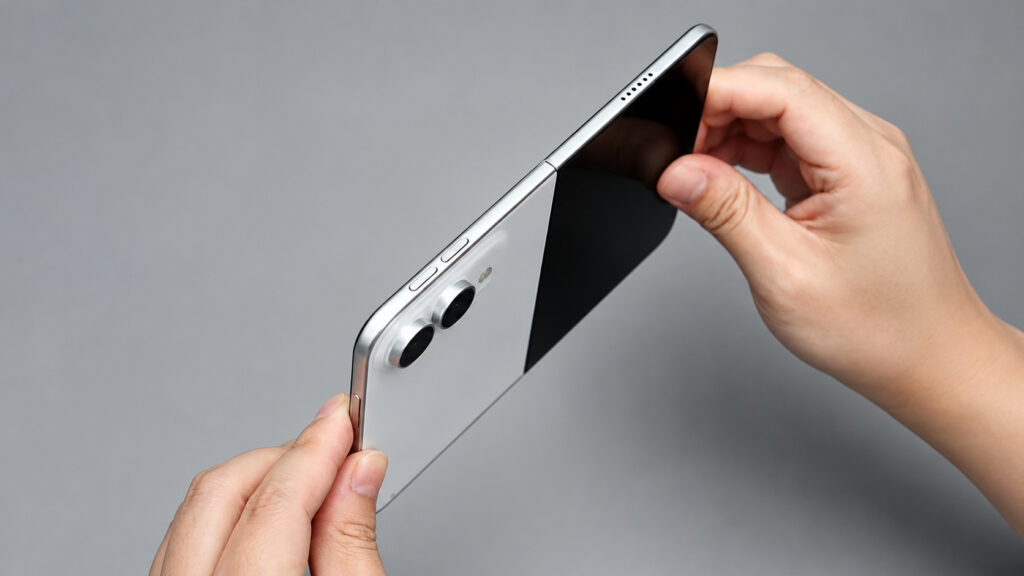
Before it was even a phone, the project was briefly something else entirely. Early concepts, developed under then-hardware chief Dan Riccio, centered on an iPad mini that unfolded into a larger tablet. Cook reportedly steered the team toward something more mainstream instead, a foldable iPhone rather than a foldable iPad, and from there Apple tested both clamshell and book-style mechanisms before converging on the book-style form by 2025. The resulting proportions are deliberately unusual: short and wide, described internally as looking like a passport when folded and a Magic Trackpad when open, a clear departure from the tall, narrow book-style foldables Samsung and others have shipped for years.
Once unfolded, the device is expected to pair a 5.5-inch outer display with a 7.8-inch inner screen, and Apple is reportedly targeting a crease that’s minimal if not fully invisible, though that specific claim isn’t confirmed. What is notable is that Apple apparently isn’t pretending this will be its best phone on paper. Gurman’s reporting says the company expects the foldable to have lower durability, a weaker camera system than the top Pro models, and worse battery life than a conventional iPhone, trade-offs the company is accepting because the pitch here is the form factor and software integration, not spec-sheet supremacy. MagSafe support is still expected to carry over despite the compromises elsewhere.
Apple’s confidence in the pricing comes from its own customer data: enough existing iPhone buyers already spend close to $2,000 on higher-storage configurations that the company reportedly believes there’s a real market for an upscale foldable, even a niche one. Internally, the expectation is that Apple will sell everything it can produce, treating this less as a mass-market phone and more as a halo product, a technology showcase that also happens to be extremely high-margin.
There’s a leadership angle here too. The foldable is described as an ideal showcase for incoming CEO John Ternus, who championed the project as Apple’s former hardware engineering chief and reportedly helped push it “over the finish line” alongside Cook. With Ternus now set to unveil it as CEO, the device carries weight beyond sales, it’s effectively the first major hardware statement of his tenure. The official name is still unconfirmed; Apple is said to be calling it the iPhone Ultra internally, though iPhone Fold has also circulated. That announcement is expected September 9 at Apple’s “Surprise and Shine” event, alongside the iPhone 18 Pro and Pro Max, with the standard iPhone 18 reportedly held back until spring 2027.
Zoom out, and the timing itself is part of the strategy. Apple is entering roughly seven years after Samsung’s original Fold, having spent that time watching hinge failures, crease complaints, and durability issues play out across the industry before committing to its own version. IDC analyst Nabila Popal reportedly expects the foldable to generate more than $45 billion in revenue for Apple by the end of 2027, even with foldables still representing a small slice, around 1.6%, of the overall smartphone market. Whether that optimism holds may depend less on the hardware itself and more on whether enough people are willing to pay upward of $2,000 for a phone Apple has already admitted won’t out-spec its own lineup.

M Adnan Akram is the founder and lead writer at Phoonomo, covering mobile technology with a primary focus on Samsung and the broader smartphone industry, alongside emerging developments in AI. He follows product launches, spec leaks, and industry trends closely to keep readers informed with timely updates.
Discover more from Phoonomo
Subscribe to get the latest posts sent to your email.