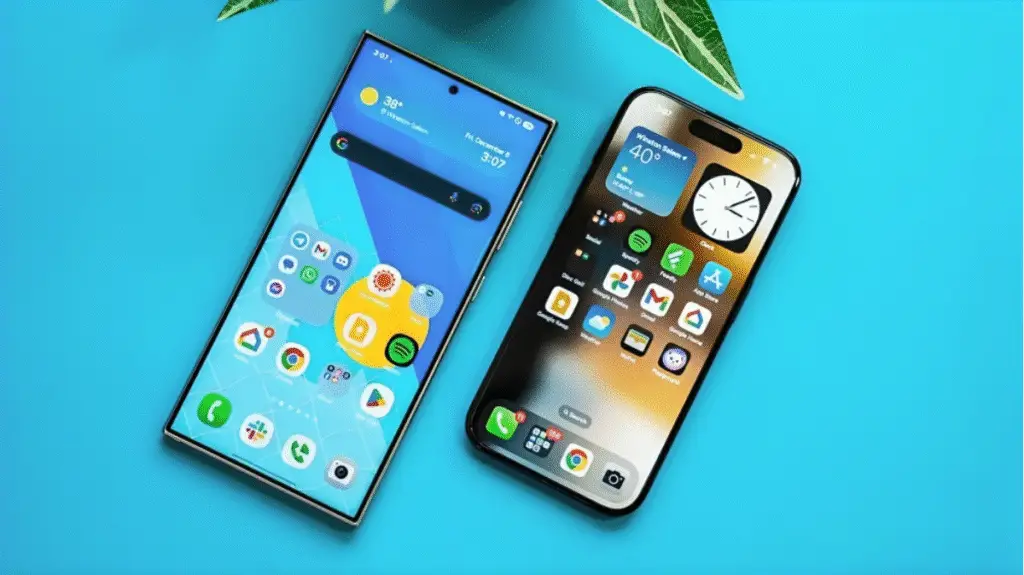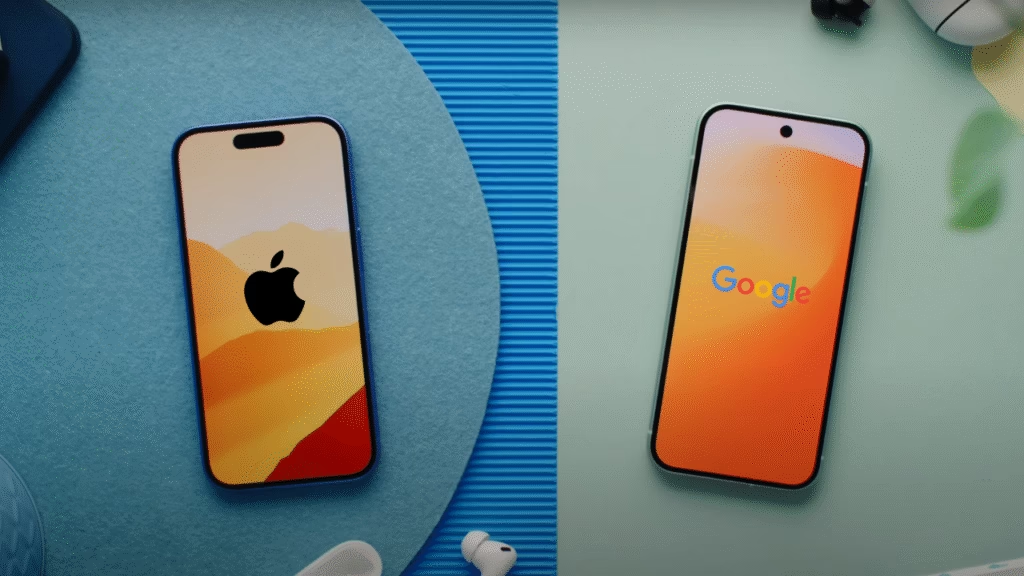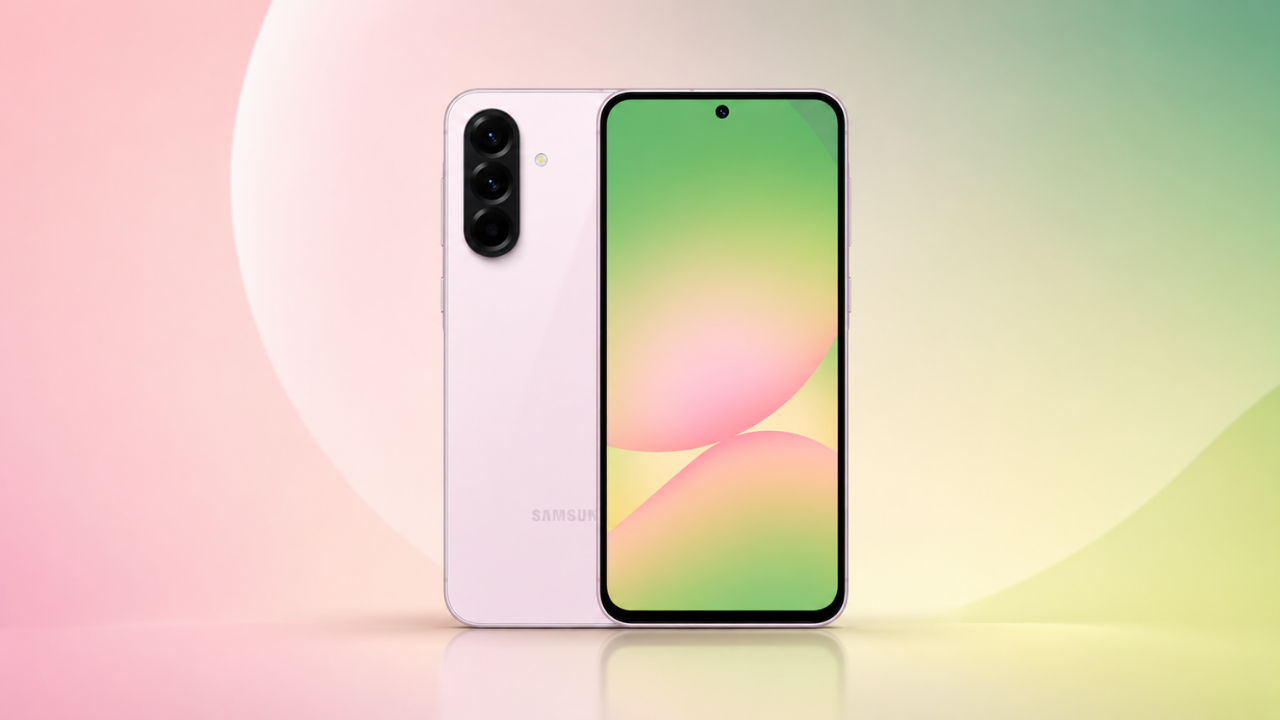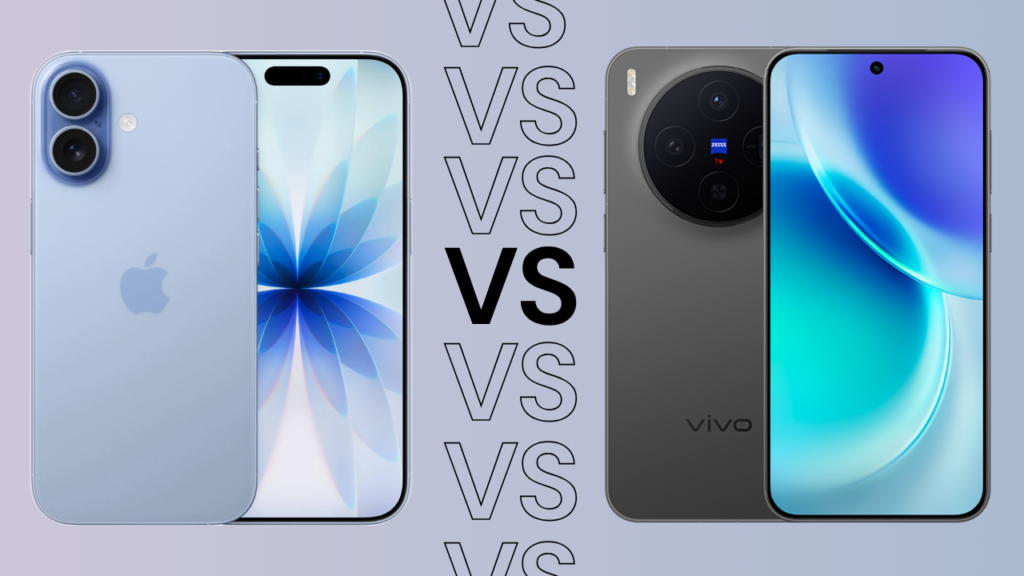
Let me be upfront about something. When I started this comparison, I fully expected the iPhone 17 to come out on top. It usually does in this price range. It has the brand, the ecosystem, the software polish that Apple has been perfecting for fifteen years. The Vivo X300 felt like the underdog, a well-specced Android phone fighting a battle it probably couldn’t win.
Two weeks later, I’m writing a very different article than I planned.
The iPhone 17 vs Vivo X300 comparison turned into one of the most genuinely interesting tests I’ve done this year. Not because one phone destroyed the other but because the Vivo won categories I never expected it to, in ways that are hard to dismiss.
Here’s everything I found.
Design Similar on the Surface, Different in the Hand
Both phones follow the flat-everything trend that’s dominated flagship design in 2026. Both are glass and aluminum. Both have a matte finish on the rear. Held side by side, they look like they belong in the same generation.
But the differences reveal themselves quickly. The iPhone 17 is lighter 177 grams on a 6.3-inch body and it feels it. Picking it up after a week with the Vivo, the iPhone almost feels too light, like something is missing inside it. The Ceramic Shield 2 front protection is reassuring and the build quality is typically Apple tight, precise, no flex anywhere.
The Vivo X300 comes in at 190 grams with a slightly velvety matte finish that I actually loved at first. It grips well, looks striking especially in the red colorway with black frame and comes with a color-matched case inside the box, which Apple still refuses to include. The circular camera module sits flush with the rear and doesn’t wobble on a flat table the way the iPhone 17 does. Small detail, genuinely annoying when you notice it.
Durability goes to Vivo too. iPhone 17 gives you IP68 up to 6 meters depth. Vivo adds IP69 which means it can survive high-pressure water jets directly on the body. Not something most people encounter daily, but the extra protection is there.
USB-C is another Vivo win. The X300 uses USB 3.2 Gen 2 standard for fast data transfers. The iPhone 17 still ships with USB 2.0 speeds through its USB-C port, a cost-cutting decision that Apple has been getting away with for too long.
Display Closer Than It Should Be
On paper both displays are nearly identical. Similar sizes, similar resolutions, similar pixel density, LTPO panels on both with 1Hz to 120Hz adaptive refresh. Symmetrical bezels. The Vivo gets slightly more usable screen area because it uses a simple punch-hole cutout instead of the Dynamic Island.
In use, there are real differences, they’re just not the ones I expected. The Vivo X300 gets brighter outdoors; it can reach a claimed 4,500 nits peak but that number only appears in extreme conditions with tiny APL content. Most real content won’t push it there. The iPhone 17 has an anti-reflective coating that handles direct sunlight better in practice, even if its raw brightness numbers are lower. So the outdoor visibility advantage swings back and forth depending on exact conditions.
In HDR video YouTube and Netflix tested side by side the iPhone gets slightly brighter in the brightest parts of scenes more consistently. Vivo is close but not quite as reliable in those peak moments.
Color reproduction on both displays is genuinely excellent. I put the Vivo in Professional Color mode to match it against the iPhone’s calibration and the difference in color accuracy between the two was minimal. Both are trustworthy for photo and video editing work.
One clear Vivo wins 2160Hz PWM dimming versus the iPhone’s lower rate. Late night usage on the Vivo was noticeably more comfortable on my eyes over extended periods. The iPhone does offer a DC dimming fallback option at lower brightness, but the Vivo is simply better here for people sensitive to screen flicker.
Speaker quality goes to iPhone; it sounds slightly richer and fuller with a wider mid-range response. Vivo’s speakers are good but not at quite the same level. For wireless audio, Vivo wins with LDAC and LHDC support that the iPhone doesn’t offer. If you have premium Bluetooth headphones, the Vivo unlocks their full quality.
Performance More Complicated Than the Benchmarks Suggest
The Vivo X300 runs the MediaTek Dimensity 9500 with the Mali G1 Ultra GPU, currently the most powerful GPU I’ve tested in any flagship phone. In 3D Mark Steel Nomad and ray tracing benchmarks, the X300 scores higher than the iPhone 17. The GPU headroom is genuinely extraordinary.
The iPhone 17 uses the Apple A19 chip consistently ahead in single-core CPU performance in Geekbench, while the Dimensity 9500 leads in multi-core results.
Gaming is where the real story emerges. In Genshin Impact both phones performed almost identically it’s become so well-optimised that most flagships handle it comfortably now. In Wuthering Wave, which pushes hardware harder, the iPhone 17 delivered higher average frame rates and ran cooler throughout extended sessions. The Vivo X300 drops frames more noticeably when thermal management kicks in the consequence of fitting an extremely powerful GPU into a compact body.
For sustained gaming performance, long sessions, high demand games the iPhone 17 is more consistent. For raw throughput in shorter bursts, the Vivo’s GPU is simply more powerful. Daily non-gaming performance? Completely identical. I couldn’t tell these phones apart in routine use.
Storage read speeds go to Vivo UFS 4.1 is faster in sequential reads. The iPhone’s NVMe storage wins on write speeds. Both are fast enough that you’ll never notice the difference in real life.
Battery and Charging Vivo Wins Clearly
The iPhone 17 has a 3,692mAh battery. The Vivo X300 has a 6,000mAh silicon carbon battery. That’s not a minor gap.
In testing, the iPhone delivered around 8 hours of screen-on time, genuinely impressive given the battery size, a testament to A19 efficiency. The Vivo reached 9 to 9.5 hours consistently. Not a massive difference in screen-on hours, but the Vivo’s larger reserve means more headroom for heavy days.
Charging is a more one-sided story. Vivo has faster wired charging, faster wireless charging, and supports reverse wireless charging. The iPhone doesn’t support reverse wireless. The Vivo also includes a charger in the box Apple still makes you buy it separately. The iPhone has MagSafe, which gives you a rich third-party accessory ecosystem, but as a charging solution the Vivo is simply faster and more complete.
Cameras This Is Where I Changed My Mind
I expected the cameras to be competitive. I did not expect the Vivo to win as convincingly as it did across most categories.
The iPhone 17 shoots 24MP default JPEGs from its primary sensor, detailed and sharp, but with a tendency to oversharpen that becomes noticeable in certain conditions. The Vivo X300 shoots 12.5MP by default but with noticeably more natural rendering details that look like they actually existed in the scene rather than being enhanced digitally. Push it to 50MP high-res mode and the advantage increases further, though it does take a moment longer to process.
Vivo offers three color modes Zeiss Natural, Vivid, and Textured. The Natural mode sits closest to iPhone’s color science, which is genuinely good color accuracy. Vivid mode actually lands closer to how the iPhone renders by default. Both phones give you control, just through different menu systems.
HDR handling is where Vivo genuinely surprised me. In high-contrast scenes with bright backgrounds, shadowed subjects the Vivo’s highlight control and shadow noise reduction is clearly better. I shot someone against harsh backlight deliberately to test this. The Vivo pulled recoverable detail from the foreground subject. The iPhone made a dark, slightly hazy mess of the same shot. That’s a real-world difference that matters for everyday photography.
Portrait mode is another Vivo win. The edge detection has improved dramatically from earlier X300 versions; the cutout accuracy at 35mm, 50mm, and 85mm focal lengths is exceptional. The Zeiss bokeh rendering has a cinematic quality that the iPhone simply doesn’t match.
Low light primary camera Vivo’s larger sensor captures more light, produces cleaner images with less lens aberration from bright sources. The iPhone’s consistent low-light lens flare issue shows up regularly in challenging artificial lighting.
The ultrawide comparison isn’t even close. Vivo’s larger ultrawide sensor produces sharper, cleaner images in both daylight and low light. The Vivo also offers tele-macro capability that the iPhone can’t compete with.
Zoom is entirely Vivo’s territory. The X300 has a dedicated 3x periscope telephoto; the iPhone 17 has no dedicated telephoto lens at all. At 3x, 6x, 10x, and 20x, the Vivo produces consistently better results. The iPhone relies on digital zoom beyond its wide lens, and it shows.
The video actually shocked me the most. I expected the iPhone to dominate. In 4K 60fps daylight shots both phones are genuinely close, with the iPhone producing more natural colors. But in low light video, the Vivo was better, something I genuinely didn’t see coming. The X300 also supports 4K 120fps and Log video recording that the iPhone 17 doesn’t offer. The selfie video and ultrawide video quality are both better on Vivo too.
Software verdict on cameras: iPhone’s computational photography is refined and consistent. Vivo’s hardware advantage is significant enough that it overcomes that deficit in most shooting scenarios. Cameras go to Vivo not by a small margin.
Software iOS Still Has Its Edge, But It’s Closer Than Before
This is genuinely the most personal category and the one where I’m most hesitant to declare a winner.
The Vivo X300 runs OriginOS 6 based on Android 16, a massive step up from the Funtouch OS experience of previous Vivo phones. It looks great, with heavy blur effects, playful animations, and thoughtful additions like the Origin Island which lets you drag and drop content to share directly to apps. The customisable control center, private space, and one-touch sharing to iPhones are genuinely useful features. Gemini AI and Circle to Search are Android advantages the iPhone doesn’t match.
I had a more stable experience with OriginOS 6 than with iOS 26 on the iPhone, which had occasional buggy moments over my testing period, something I wasn’t expecting to say.
But iOS still has that design polish and refinement that is honestly hard to articulate but immediately obvious when you use it. The contextual menus, the animation quality, the overall premium feeling of the interface Apple has been perfecting this for fifteen years and it shows. OriginOS 6 is excellent. iOS 26 feels slightly more considered in the small details.
It’s close enough to be a genuine matter of personal preference.
Final Verdict
If I’m being completely honest about the iPhone 17 vs Vivo X300 comparison the Vivo wins on hardware. Better cameras across almost every category, better battery, faster charging, superior USB standard, stronger GPU, and more photography flexibility. For a hardware-to-hardware comparison, the X300 is the more impressive engineering achievement.
The iPhone wins on software consistency, gaming sustainability, ecosystem depth, AirPods integration, Apple Watch compatibility, MagSafe accessories and the intangible but real quality of iOS’s design refinement. If your life already runs on Apple products, that ecosystem value is real and worth paying for.
If you want the most capable hardware for the money Vivo X300 is the answer. If you want seamless ecosystem integration and iOS’s fifteen years of polish iPhone 17 is still worth every penny.
Discover Also Pixel 10 vs OnePlus 15 I Used Both for Weeks and the Result Surprised Me

M Adnan Akram is the founder and lead writer at Phoonomo, covering mobile technology with a primary focus on Apple and the broader smartphone industry, alongside emerging developments in AI. He follows product launches, spec leaks, and industry trends closely to keep readers informed with timely updates.
Discover more from Phoonomo
Subscribe to get the latest posts sent to your email.