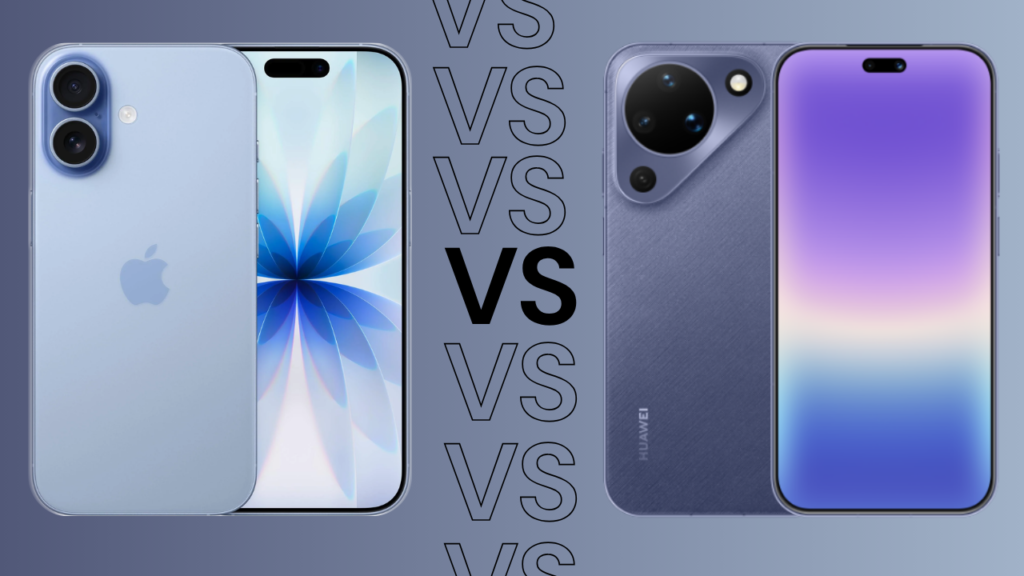
Two phones. Two completely different worlds. One from Apple, running the most polished mobile software on the planet. One from Huawei, a company that got cut off from Google services, American chips, and global supply chains and somehow came back stronger, angrier, and more interesting than ever. The iPhone 17 vs Huawei Pura 90 comparison is not just about specs. It’s about two completely different philosophies of what a premium smartphone should be. I spent time with both. Here’s what I actually found.
First Impressions Picking Them Up Changes Everything
The moment you pick up both phones, the size difference hits you immediately. The iPhone 17 is compact 149.6 x 71.5mm, 177 grams small enough to use one-handed without thinking about it. The Pura 90 is a different beast entirely. 163.1 x 78.1mm, 210 grams. That’s 33 grams heavier and significantly taller. In your pocket, you feel it. In your hand, it feels substantial rather than premium. There’s a difference.
The iPhone feels more expensive in the hand despite costing similarly. Ceramic Shield 2 on the front, glass back, aluminum frame tight tolerances, no flex, nothing creaks. The Pura 90 uses Kunlun Glass up front Huawei’s own toughened glass that has genuinely impressive drop-test credentials with an aluminum frame and a premium finish. It looks great. It just doesn’t feel as dense and precise as the iPhone.
Water resistance is where the Pura 90 does something genuinely impressive. IP68 and IP69 the 69 rating means it can handle high-pressure hot water jets, something the iPhone’s IP68 rating doesn’t cover. In real life, IP68 is already enough for any realistic situation. But the Pura 90 going the extra mile here says something about how seriously Huawei takes durability.
Display Numbers Don’t Tell the Full Story
On paper, the Pura 90 looks like the winner here. 6.8-inch LTPO OLED at 463 ppi versus the iPhone 17’s 6.3-inch LTPO Super Retina XDR at 460 ppi. Both are LTPO with 120Hz adaptive refresh. Both are stunning in daily use.
But sitting with both phones in real conditions, the iPhone’s display does something the Pura 90 doesn’t; it reaches 3000 nits peak brightness. I tested both outdoors on a bright afternoon and the iPhone 17 was simply more readable. GSMArena’s lab measured the iPhone at 1012 nits sustained, which is solid but not remarkable. The Pura 90’s 1320 x 2856 resolution gives it a crisper, more detailed look at close inspection text rendering on the Pura 90 is genuinely beautiful.
The Pura 90’s larger screen is better for media consumption, reading, and multitasking. The iPhone 17’s screen is better calibrated, more color-accurate, and hits higher brightness when you actually need it outdoors. Both are excellent. Your preference depends on whether you want size or calibration.
One thing the Pura 90 has that I genuinely appreciated is PWM dimming that’s actually comfortable at low brightness. Late night use on the Pura 90 was easier on my eyes than expected. iPhone 17 handles low brightness fine but doesn’t call attention to itself the same way.
Performance A Complicated Story in 2026
This is the section that requires the most honesty. The iPhone 17 runs the Apple A19 chip on 3nm, one of the fastest mobile processors ever made. AnTuTu score of 2,109,773. GeekBench single core of 9,360. These are class-leading numbers and the performance in daily use reflects it. Everything is instant. Animations are fluid. Heavy apps open without hesitation. Gaming is exceptional.
The Huawei Pura 90 runs the Kirin 9010s at 7nm. That’s a meaningful process, node gap 7nm versus 3nm is not a minor difference in 2026. Benchmark numbers confirm that the Kirin 9010s trails significantly in raw computational performance. In daily use though, the Pura 90 doesn’t feel slow. It handles everything most people do without obvious hesitation. The gap shows more in sustained heavy tasks, extended gaming sessions, large video exports, intensive multitasking where the iPhone simply doesn’t slow down and the Pura 90 starts to feel the pressure.
For 95% of daily use messaging, social media, photography, streaming most people wouldn’t feel the difference. For the other 5%, the iPhone 17 is in another league entirely.
The RAM story favours Huawei though 12GB or 16GB versus the iPhone 17’s 8GB. In practice, iOS manages memory so efficiently that 8GB rarely feels limiting. But for heavy multitasking and keeping many apps alive simultaneously, the Pura 90 has headroom the iPhone 17 doesn’t.
Cameras Where It Gets Really Interesting
Both phones have triple rear cameras. But the configurations are meaningfully different.
The iPhone 17 runs a dual rear camera system 48MP wide and 48MP ultrawide, no telephoto. That’s right, no optical zoom beyond the wide lens. Digital zoom only beyond 2x. For a phone at this price in 2026, that’s a gap that matters.
The Pura 90 gives you three cameras that actually cover three different focal lengths properly: 50MP wide, 50MP periscope telephoto at 3.7x optical zoom, and 12.5MP ultrawide. The telephoto alone changes how you photograph. Wildlife, events, architecture from a distance, candid portraits from across a room the Pura 90 handles all of it natively. The iPhone 17 reaches for digital zoom and the results are noticeably softer beyond 2x.
In daylight, both cameras are excellent for standard photography. The iPhone’s processing is more natural and consistent colors look accurate, dynamic range is handled intelligently, and skin tones are particularly good. Huawei’s processing is more aggressive; it sharpens more, saturates slightly more, and sometimes produces images that look great on a phone screen but are slightly over-processed on a large monitor.
Night photography is genuinely close. Both produce usable, clean results in low light. The iPhone’s larger 1/1.56″ main sensor captures more light naturally, and Apple’s computational photography pipeline is world-class. The Pura 90 fights back with a color spectrum sensor that helps identify and reproduce tricky lighting conditions more accurately particularly in mixed artificial lighting indoors.
Video is firmly iPhone territory. Dolby Vision HDR, ProRes-quality processing, Cinematic mode Apple’s video ecosystem is the best on any smartphone. The Pura 90 does 4K and 1080p well, and its 1080p@480fps interpolated slow motion is a fun party trick. But for anyone who creates video content seriously, the iPhone 17 is the tool and the Pura 90 is not.
Selfie cameras both shoot 50MP. The iPhone’s 18MP front camera sounds lower on paper but the multi-aspect sensor and PDAF give it flexibility. Face ID depth sensing means Apple’s front camera system does significantly more than take selfies. Huawei’s 50MP front camera with autofocus takes sharper, more detailed selfies in good light.
Battery Huawei Wins Clearly
This isn’t close. The Pura 90 packs a 6,500mAh battery with 100W wired charging that hits 100% in 45 minutes. The iPhone 17 has a 3,692mAh battery with slower charging roughly 50% in 20 minutes via wired, but full charge takes significantly longer.
In real use, the iPhone 17 still manages impressive endurance 14 hours 59 minutes active use in lab testing thanks to the A19 chip’s exceptional efficiency. The Pura 90’s larger battery means it lasts longer in heavy use scenarios and charges back up in under an hour. Day-to-day, both phones comfortably last a full day. The Pura 90 lasts longer into a second day for heavy users.
Wireless charging also goes to Huawei 50W wireless versus Apple’s 25W MagSafe. Both support reverse wireless charging. Both have USB-C. The Pura 90 additionally supports 5W reverse wired charging, which the iPhone 17 doesn’t match.
Software Two Completely Different Ecosystems
The iPhone 17 runs iOS 26 the most refined, secure, and well-integrated mobile operating system available. App quality is higher on iOS, privacy controls are more granular, and the ecosystem integration with Mac, iPad, Apple Watch, and AirPods is genuinely seamless. If you’re already in Apple’s world, iOS makes everything better.
The Pura 90 runs HarmonyOS 6.1 Huawei’s own operating system that has matured significantly. No Google services means no Gmail, Google Maps, YouTube, or Play Store by default. Huawei’s AppGallery has improved but still has gaps that matter depending on what apps you rely on. For users in China where Google services aren’t used anyway, this is completely fine. For international users, it requires real adjustment.
One hardware feature the Pura 90 has that Apple doesn’t have is an infrared blaster. Small things. Genuinely useful for controlling TVs and air conditioners. Also has BDS Satellite Messaging for China users. The iPhone counters with Emergency SOS and Find My via satellite and Ultra Wideband support is more useful internationally.
Price and Value
The Pura 90 launches at approximately €590 significantly less than the iPhone 17’s €724. For that price difference, the Pura 90 gives you a bigger screen, more battery, faster charging, and a proper telephoto camera. The iPhone 17 gives you better performance, superior software ecosystem, better video, and seamless global connectivity.
Final Verdict (iPhone 17 vs Huawei Pura 90)
If you’re outside China and rely on Google services, the choice is the simple iPhone 17. The software gap, performance gap, and ecosystem advantage are too significant to overlook regardless of how impressive the Pura 90’s hardware is on paper.
If you’re in China, value battery life and camera versatility over raw power, or genuinely don’t need Google services, the Pura 90 at €590 is a remarkable value that challenges phones costing significantly more.
Both phones are genuinely great. The right one depends entirely on which ecosystem your life already runs on.
Discover Also Xiaomi 17 Ultra vs Vivo X300 Ultra Two Very Different Takes on What a Camera Phone Should Be

M Adnan Akram is the founder and lead writer at Phoonomo, covering mobile technology with a primary focus on Apple and the broader smartphone industry, alongside emerging developments in AI. He follows product launches, spec leaks, and industry trends closely to keep readers informed with timely updates.
Discover more from Phoonomo
Subscribe to get the latest posts sent to your email.