Guys, anyone who understands tech knows that right now there is no better camera phone in the market than the Vivo X300 Pro and Oppo X9 Pro. And no doubt about it. The more I tested these phones, one thing became clear: Oppo and Vivo are now entering the ultimate category.
I have never had this much difficulty judging two camera phones like this before. But still, after properly testing both phones, I have some solid points that you should know.
So click on subscribe, because today I am not going to talk about general tech stuff. At the same time, if you truly want to buy a very good camera phone, I can help you make a good decision.
First, let’s quickly discuss the design of both phones.
Design
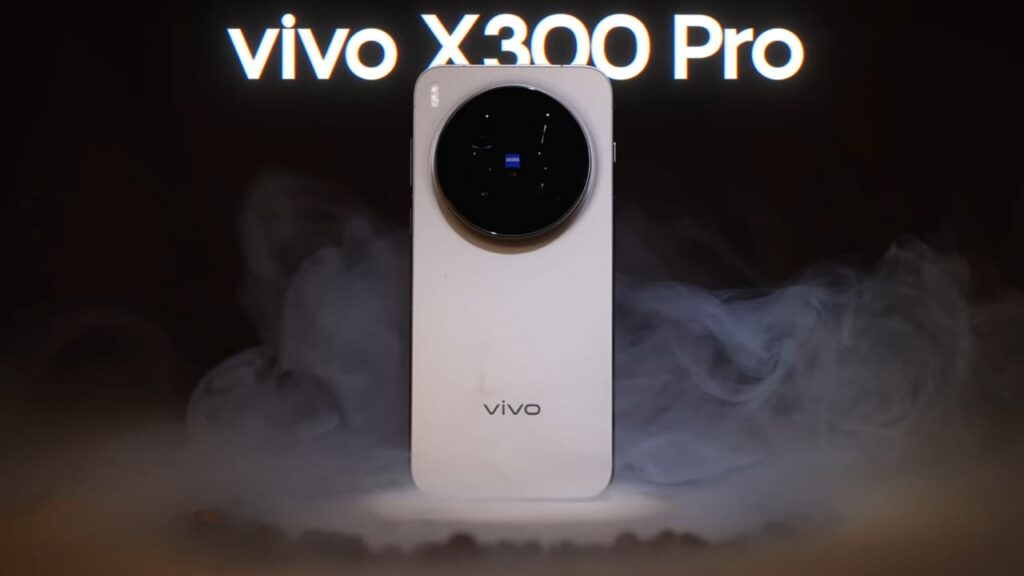
I know that it feels like Vivo has been making circular camera modules for a long time. Somewhere we have become used to this design language, but at the same time, it feels like we have already seen this design before.
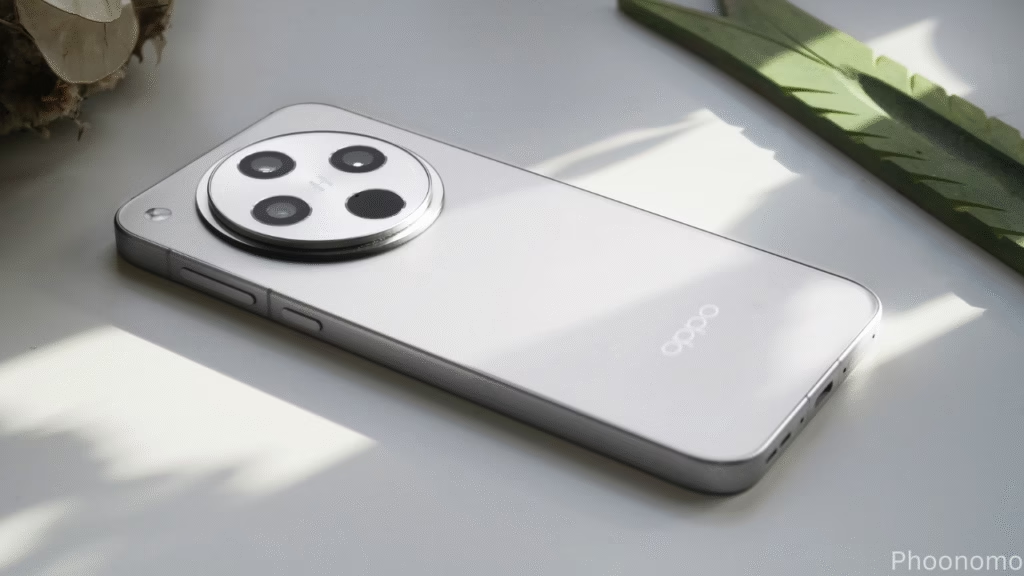
On the other hand, if we talk about Oppo, this phone follows a more modern design language and feels refreshing.
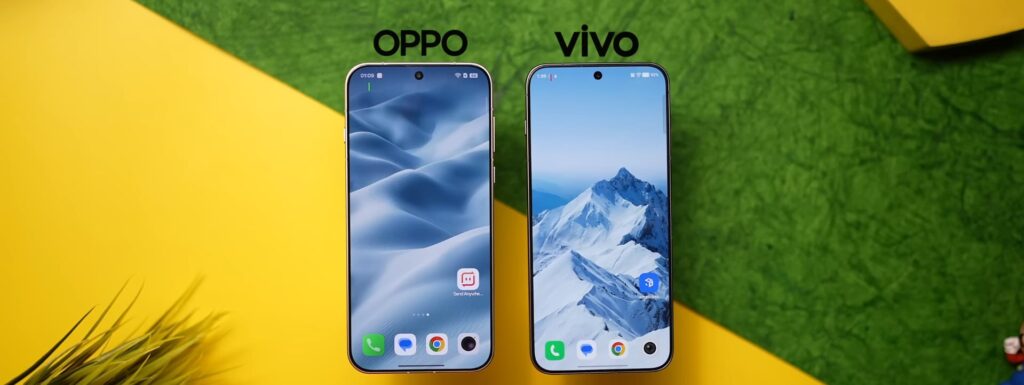
In fact, I noticed one thing. If I place both phones on a flat surface, the Vivo remains quite inclined, while the Oppo feels more flat. Basically, I want to explain that Vivo’s camera module is very thick. When you put the phone in your pocket, the camera module remains very visible. Recently, we have noticed a trend that all expensive Android phones are starting to give an action button like Apple. This applies to both phones because both Oppo and Vivo come with an extra button.

But Vivo has an advantage: we can assign two actions at the same time. For example, I set one for the torch and another for ring and vibrate mode.
But Oppo also has an advantage. Along with its action button, it also gives a camera control button like the iPhone. After proper testing, I liked Vivo’s speakers more, but I felt Oppo’s haptic feedback was stronger.
Both phones come with an ultrasonic fingerprint scanner, which is a good technology.So you now have a basic idea of how these phones look. Now let’s talk about the most important thing: Cameras.
Camera
Both phones come with a 50 + 50 + 200MP camera setup. The 50MP main camera in both phones uses the same LYT 828 sensor. It is a very good sensor. The 50MP ultra-wide lens is also the same in both phones. The sensor size is the same, but Oppo is slightly more advanced. The difference is in the telephoto lens. Vivo uses the HPB sensor, while Oppo uses the HP5 sensor.In simple words, Vivo’s sensor is better because it is larger and is a proper flagship sensor. Oppo’s telephoto sensor is slightly smaller and is more like a mid-range sensor. Because Vivo’s sensor is bigger, it gathers more light, so low-light telephoto photos are better. However, Oppo’s 3X zoom feels like a sweeter focal length compared to Vivo’s 3.5X, because with Vivo you have to step back more.
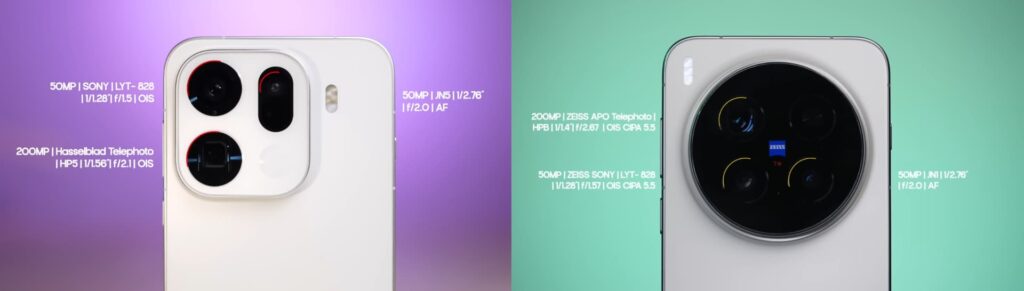
After capturing many pictures, I realized Oppo brings very good detail in its photos. By default, Oppo captures 50MP photos, so when you zoom in, more detail is visible. Vivo also has a 50MP option, but when you use it, it takes slightly more time to capture the photo.
Daylight HDR Performance
Vivo has been the king of daylight HDR for a long time. Oppo has caught up and now also gives very good HDR. But still, Vivo remains more consistent. In many situations, Vivo performs better. For example, in the dog photo, Vivo clearly performed better.

Low-Light Photography
In low light, shadow retention and highlight control are very important. Vivo processes shadows better and also controls highlights better. In these photos, Vivo controlled the hoardings’ highlights very well. Oppo has improved a lot, but Vivo is still ahead.
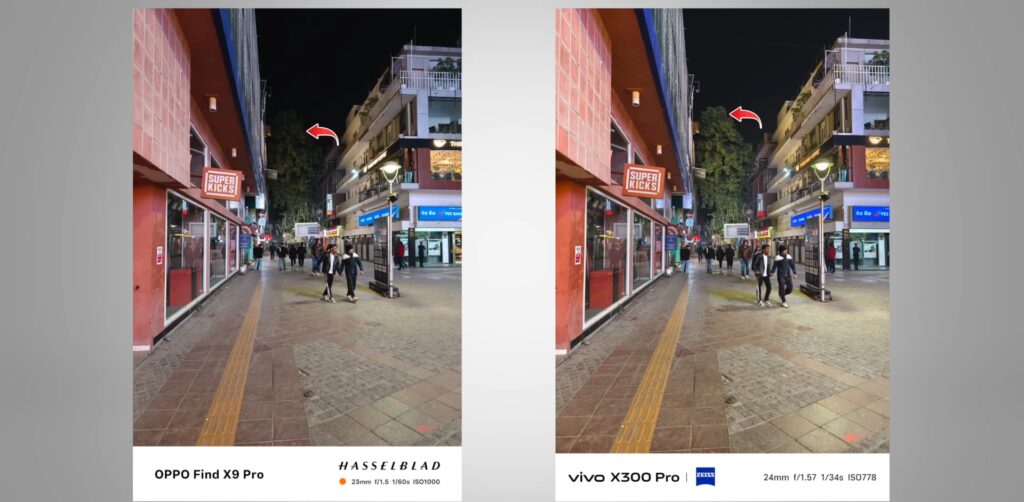
Vivo has been criticized for smoothing too much between 35mm and 50mm focal length. This year too, Vivo still smooths images more than Oppo. Oppo retains better details in portraits, while Vivo still applies smoothing. Many people like smoothing because everyone wants clear skin. But Vivo phones are used by photographers, so a natural option would be better.
Vivo’s camera hardware is better, so short periscope shots are better on Vivo. Vivo is still considered the king of portraits because of its multiple blur styles and artistic effects. So in portraits, Vivo is still better.
Macro Photography
Oppo can go very close to the subject, which is a good advantage. But because Vivo’s sensor is bigger, it gives more cinematic macro shots.

Zoom Performance
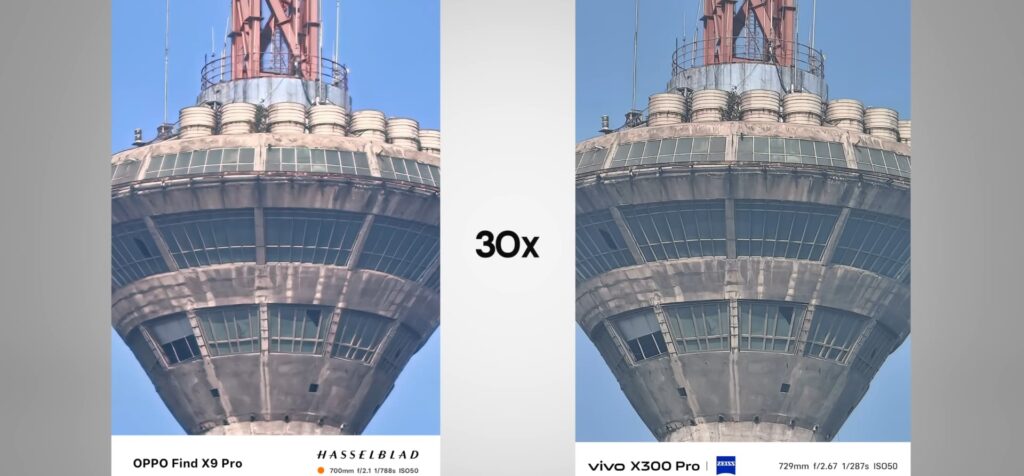
The 10X to 30X zoom range is the most usable. Here Vivo performs better because Oppo starts showing AI smoothing after 10X. These phones push camera limits so much that they now bring camera kits to Global.
Camera Kits Comparison
Oppo’s camera kit is more expensive than Vivo’s. Oppo gives an extra attachment that allows tripod and monopod mounting. Vivo’s kit is more functional because other cameras are not blocked after attaching the lens. In Oppo, other cameras get covered after attaching the lens. Because Vivo’s periscope lens is more advanced, higher zoom photos are better on Vivo even with the kit.
Color Processing & Degree of Failure
Oppo tries to stay natural, while Vivo gives a more vibrant output. Degree of failure means how badly a camera can fail. Vivo may sometimes increase contrast or saturation. Oppo can fail in multiple areas white balance, contrast, and saturation. So Vivo is more consistent. This applies to front cameras too.
Selfie Camera Consistency
Some Oppo selfies look flat, while some become over-saturated. Vivo uses more consistent processing. So again, Vivo has the advantage.
Video Recording
Both phones support 4K 120fps. But Vivo also supports 8K and 4K 60fps portrait video, which Oppo does not. Lens switching is smoother on Vivo. Oppo does better HDR when the sun is in the background. Overall, Vivo has more video features.
Display Comparison
Both phones have excellent LTPO displays.Outdoor brightness is slightly better on Vivo (2000 nits vs 1800 nits). HDR playback also looks brighter on Vivo.
Battery & Charging
Oppo has a 7500mAh battery. Vivo has 6510mAh. Almost 1000mAh difference, so Oppo clearly wins in battery.
Charging:
- Vivo 90W — full charge in 50 minutes 12 seconds
- Oppo 80W — full charge in 1 hour 15 minutes
Oppo is better overall in the battery department.
Performance & Gaming

Both phones use the same processor, RAM, and storage. Benchmark scores are similar.
Heavy games:
Genshin Impact (30 minutes)
- Vivo: 59.2 FPS
- Oppo: 51.9 FPS
Wuthering Waves
- Vivo: 49.5 FPS
- Oppo: 45.4 FPS
Vivo gives higher FPS but heats more.
Oppo uses safer tuning for temperature and battery.
Software Experience

Earlier, ColorOS was clearly better than Vivo’s UI. But since OriginOS came to Vivo, things have changed.
Update policy:
- Oppo: 5 Android + 6 security years
- Vivo: 5 Android + 7 security years
OriginOS is smoother and more feature-rich now, but still has some bugs. ColorOS is still more stable.
Final Verdict (Vivo X300 Pro vs OPPO Find X9 Pro)
If we look at design, battery, and software, Oppo X9 Pro is stronger. Vivo always brings more camera features, especially in portraits and video. From a pure camera point of view, Vivo X300 Pro is still the better camera phone. But overall, the Oppo X9 Pro is a more balanced phone.
So if you are confused:
- Oppo X9 Pro = Balanced phone
- Vivo X300 Pro = Camera-focused phone
Now tell me in the comments which phone would you buy? If you like this comparison hit the button and subscribe to join our tech army. We believe in quality. See you next time. Thanks for reading. Bye guys.
Discover More Oneplus 15R vs Oneplus 13R – Flagship Killer is Back?
Discover more from Phoonomo
Subscribe to get the latest posts sent to your email.