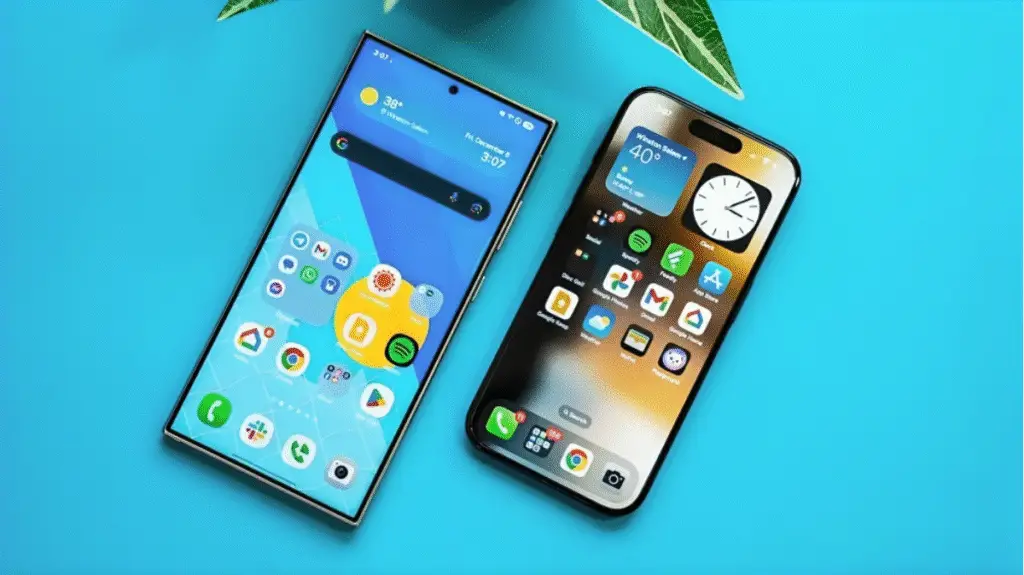
It’s been one year since the launch of the Pixel 9 Pro and the iPhone 16 Pro. I use the Pixel phone as an Android developer because it always gets the latest Android versions, including the beta ones. I use the iPhone for work because of its better integration with my MacBook. These two phones are basically the smaller versions of their larger counterparts, the iPhone 16 Pro Max and the Pixel 9 Pro XL. The iPhone is still a bit smaller, though, as the Pixel has a larger display and a larger battery. Today, we are going to compare the battery life, software features, display, thermals, and camera performance after the updates the phones have received.
Design and Durability
This year, Google seems to have taken a page from Apple’s playbook. The Pixel 9 Pro comes across as the iPhone of the Android world, and when you hold it next to the iPhone 16 Pro, it’s easy to see why people say that. Both phones share almost identical size, shape, and in-hand feel. The Pixel is just a touch taller, but the overall build feels just as premium.
They both feature flat frames with rounded corners and clean transitions from glass to metal. The Pixel uses polished aluminum, which feels slightly more reflective and slippery compared to Apple’s matte titanium finish. While the iPhone feels cooler and a bit more luxurious, the Pixel’s shiny frame gives it a distinct charm.
Looking at them side by side, the only real visual difference lies in the camera design. Apple still sticks with its triangular camera layout, while Google continues with its bold horizontal camera bar that stretches across the back. That camera bar may not be everyone’s favorite, but it does one thing very well: it keeps the phone from wobbling when lying flat.
Both are IP68-rated for water and dust resistance. Apple claims it can survive deeper submersion (up to 6 meters), while Google’s rating sits at the usual 1.5 meters. In everyday use, that makes little difference both will easily survive splashes, rain, or the occasional sink drop. However, with its titanium frame and Ceramic Shield glass, the iPhone 16 Pro likely has the upper hand in overall durability.
| Feature | Pixel 9 Pro | iPhone 16 Pro |
|---|---|---|
| Frame Material | Polished Aluminum | Grade 5 Titanium |
| Front Glass | Gorilla Glass Victus 2 | Ceramic Shield |
| Water Resistance | IP68 (1.5m) | IP68 (6m) |
| Weight | 214g | 214g |
| Dimensions | 162.7 x 76.8 x 8.5mm | 146.6 x 70.6 x 8.3mm |
Features
Apple and Google both aim for simplicity, but they approach it differently. The iPhone’s Dynamic Island and camera control button give it an edge in hardware-based convenience. The button, which lets you adjust zoom and exposure levels, is a neat addition for photography lovers. It’s not a must-use feature, but once you get used to it, it can feel natural especially when holding the phone horizontally for video or photos.
The Pixel doesn’t have a dedicated camera button, but Google leans heavily on smart features. It’s powered by AI tools baked right into the phone, like real-time transcription, on-device translation, and Gemini Live, which lets you talk to the Assistant naturally to plan, write, or research. While Apple is still preparing its Apple Intelligence rollout, Google’s AI tools already feel polished and ready for daily use.
Security is another point of difference. Apple’s Face ID uses dedicated depth sensors for facial mapping, while Google’s system is purely camera-based. Both unlock fast and accurately, but Face ID still feels more secure due to its 3D depth recognition.
Display and Software
In display quality, these two flagships are closer than ever. Both sport 6.3-inch LTPO OLED panels with 120Hz adaptive refresh rates. They can reach around 2000 nits peak brightness, making them easy to use even under harsh daylight.
Color tuning is another area where they surprisingly align. Both lean toward warmer tones out of the box, though the iPhone’s color balance skews more toward golden-yellow, while the Pixel adds a hint of red. Watching videos or photos, you’ll notice the Pixel sometimes gives skin tones a slightly pinkish hue compared to Apple’s more natural tone.
When it comes to real brightness and outdoor visibility, Apple takes a small win. The iPhone 16 Pro appears slightly brighter during video playback, while the Pixel 9 Pro often needs a manual brightness bump. Still, both are excellent screens with sharp detail and smooth animations.
The main software difference lies in personality. Apple offers the polished and cohesive iOS 18, while Google gives you the open, customizable Android 15 experience. For users who like freedom to tweak layouts and rely on AI-driven tools, Pixel takes the edge. But if you prefer stability and a tightly integrated ecosystem, Apple still feels more refined.
| Feature | Pixel 9 Pro | iPhone 16 Pro |
|---|---|---|
| Display Size | 6.3-inch LTPO OLED | 6.3-inch LTPO OLED |
| Resolution | 1344 x 2992 | 1179 x 2556 |
| Refresh Rate | 1–120Hz | 1–120Hz |
| Peak Brightness | 2000 nits | 2000 nits |
| Software | Android 15 + Gemini AI | iOS 18 + Apple Intelligence (coming) |
Performance and Battery Life
Performance is where these two parts are. The A18 chip inside the iPhone 16 Pro is leagues ahead of Google’s Tensor G4. Benchmarks aside, Apple’s phone feels snappier when loading large games or switching between heavy apps. The Pixel 9 Pro isn’t slow by any means, but it doesn’t chase raw numbers. Google built its chip for AI processing and camera smarts, not record-breaking speed.
When gaming, the iPhone handles graphically demanding titles with smoother frame rates and cooler thermals. The Pixel manages fine for everyday use but shows more heat and battery drain during longer gaming sessions.
Battery life tells a similar story. Both devices can last a full day, but the iPhone stretches slightly further, especially for video playback or gaming. On lighter use, both will easily survive till bedtime, but the iPhone consistently ends with around 10% more battery left.
Wireless charging is fast on both, though Apple’s MagSafe connection feels more practical than Google’s standard Qi charging pad.
| Feature | Pixel 9 Pro | iPhone 16 Pro |
|---|---|---|
| Processor | Google Tensor G4 | Apple A18 Bionic |
| RAM | 12GB | 8GB |
| Storage | Up to 1TB | Up to 1TB |
| Battery | 5050mAh | 3580mAh |
| Charging | 30W wired / Qi wireless | 27W wired / MagSafe wireless |
Camera and Video
Both phones bring triple-camera setups, offering a main, ultrawide, and 5x telephoto lens. The differences, however, come in tone and feel. The Pixel’s photos look richer and warmer by default, while the iPhone aims for natural and balanced output.
In daylight, the iPhone’s shots sometimes look a bit sterile, accurate but slightly less punchy. The Pixel, on the other hand, delivers more contrast and color pop, making outdoor photos instantly Instagram-ready.
When it comes to low light, the Pixel often captures brighter, sharper images. However, it can occasionally overexpose and make night scenes look more like day. The iPhone, though slower to trigger night mode, keeps lighting more realistic once it engages.
Macro photography leans in Apple’s favor, with the iPhone 16 Pro focusing more precisely on tiny subjects. Video quality is another area Apple continues to dominate. With ProRes and Log recording, better color accuracy, and smoother stabilization, the iPhone’s videos look more cinematic. The Pixel 9 Pro’s videos appear slightly darker and less consistent in focus, especially when zooming.
| Feature | Pixel 9 Pro | iPhone 16 Pro |
|---|---|---|
| Main Camera | 50MP (f/1.7) | 48MP (f/1.8) |
| Ultra-wide | 48MP | 12MP |
| Telephoto | 48MP (5x optical zoom) | 12MP (5x optical zoom) |
| Video | 4K 60fps | 4K 60fps (ProRes, Log) |
| Front Camera | 10.5MP | 12MP TrueDepth |
Verdict: Which One Should You Choose?
After testing both side by side, it’s clear why people call the Pixel the iPhone of the Android world. These two phones feel closer than any Google–Apple matchup before.
If you value raw power, battery efficiency, and industry-leading video capture, the iPhone 16 Pro is still the safer pick. It’s fast, reliable, and future-proof especially within Apple’s ecosystem.
But if you love photography, smarter AI tools, and the creative flexibility of Android, the Pixel 9 Pro delivers more personality. Google’s camera tuning gives photos a distinct warmth, and its built-in AI tools genuinely add value rather than being simple gimmicks.
Both start around $999 in the U.S., and both promise seven years of software support. That makes the decision more about ecosystem preference than performance.
In short: Apple wins on polish and power, Google wins on creativity and smart features. No matter which one you choose, you’re getting one of the best compact flagships of the year.
See Also Google Pixel 9 Pro XL vs iPhone 15 Pro Max
FAQs (Pixel 9 Pro vs iPhone 16 Pro)
Which phone is better for photography: Pixel 9 Pro or iPhone 16 Pro?
Both phones take amazing photos, but the Pixel 9 Pro has the edge in AI-based photography and low-light shots. The iPhone 16 Pro still wins in video quality and consistency.
Does the Pixel 9 Pro have better battery life than the iPhone 16 Pro?
Battery life is close, but the iPhone 16 Pro lasts a little longer in heavy use thanks to Apple’s efficient A18 Pro chip.
Which one is better for gaming?
The iPhone 16 Pro handles high-end games more smoothly with its A18 Pro processor, though the Pixel 9 Pro also performs very well for most modern games.
How long will these phones get software updates?
Google promises 7 years of updates for the Pixel 9 Pro, matching Apple’s long support for iPhones, which is usually around 5–7 years.
Should I upgrade from Pixel 8 Pro or iPhone 15 Pro?
If you already own last year’s model, the jump isn’t huge. But if you want better AI features, faster performance, and improved cameras, both upgrades are worth considering in 2025.
Discover more from Phoonomo
Subscribe to get the latest posts sent to your email.