Apple’s long-rumored foldable iPhone is starting to feel less like a concept and more like an inevitable product category shift. A new report from Apple via supply chain leaks and dummy models suggests the so-called “iPhone Fold” may take a very different direction from what we’ve seen in foldables so far.
And if these details hold true, Apple isn’t just making a foldable phone it’s redefining what an iPhone becomes when it unfolds.
The most striking detail is the ~7.8-inch inner display. On paper, that doesn’t sound dramatically larger than a modern Pro Max iPhone. But in practice, it’s a completely different experience.
Why? Aspect ratio.
Unlike many foldables that lean toward a squarer canvas, Apple’s approach reportedly keeps the display more rectangular, closer to what you’d expect from an iPad mini. That means:
- Better video playback (less black bars)
- More natural app scaling
- A clearer “mini tablet” identity
This aligns with a bigger idea: Apple appears to be prioritizing the unfolded experience first, not the closed one.
That decision comes with consequences.
When folded, the device is said to be:
- Shorter but noticeably wider than a typical iPhone
- Closer to a “passport” shape than a traditional slab
In real-world terms, that could mean:
- Harder one-handed use
- A bulkier feel in pockets
This is where Apple diverges from competitors like Samsung, whose Galaxy Z Fold series tries to balance both modes more evenly.
Apple, at least based on this leak, seems comfortable making the closed experience a compromise as long as the open one shines.
If there’s one area where Apple may leap ahead, it’s thickness.
- Unfolded: less than 5 mm
- Folded: around 9.5 mm
For context, modern flagship phones sit around 8–9 mm thick. So while the foldable might be slightly thicker when closed, it becomes exceptionally thin when opened, potentially the thinnest iOS device ever.
That kind of engineering doesn’t come easy, and it likely explains another major change.
To achieve that thin profile, Apple is reportedly dropping Face ID entirely on this device.
Instead, it may return to:
- Touch ID in the side button
This isn’t unprecedentedApple has used this approach in iPadsbut it does signal a clear compromise. Packing advanced facial recognition hardware into such a thin folding chassis appears to be a challenge Apple hasn’t solved yet.
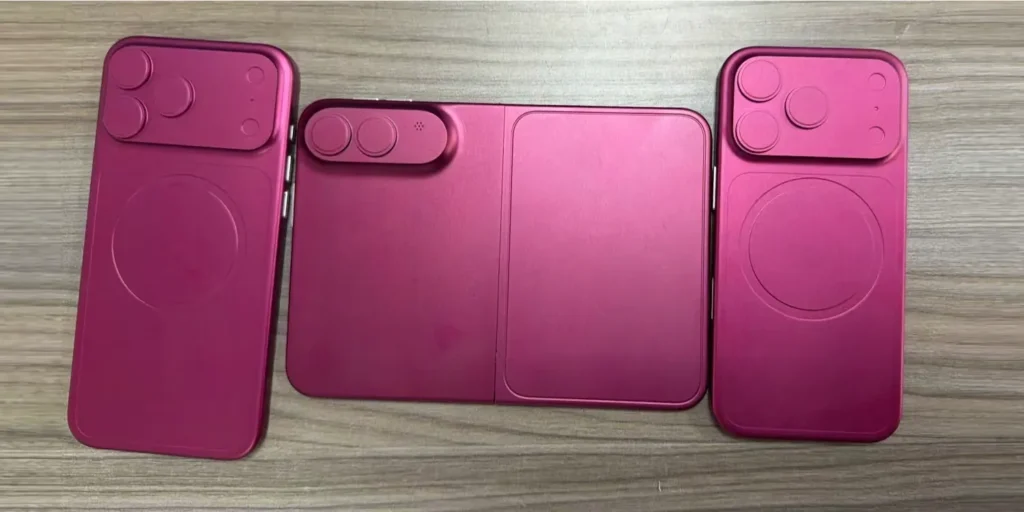
The current information comes from early dummy units, commonly used by accessory makers. These give us a sense of:
- Size
- Shape
- Physical proportions
But they’re not final.
For example:
- The visible hinge in these models is likely not representative of the final product
- Apple is expected to minimize or nearly eliminate the crease
- Key elements like cameras and MagSafe details are missing
So while the dimensions are useful, the finish and polish are still unknown.Apple’s long-rumored foldable iPhone is starting to feel less like a concept and more like an inevitable product category shift. A new report from Apple via supply chain leaks and dummy models suggests the so-called “iPhone Fold” may take a very different direction from what we’ve seen in foldables so far.
And if these details hold true, Apple isn’t just making a foldable phone it’s redefining what an iPhone becomes when it unfolds.
The most striking detail is the ~7.8-inch inner display. On paper, that doesn’t sound dramatically larger than a modern Pro Max iPhone. But in practice, it’s a completely different experience.
Why? Aspect ratio.
Unlike many foldables that lean toward a squarer canvas, Apple’s approach reportedly keeps the display more rectangular, closer to what you’d expect from an iPad mini. That means:
- Better video playback (less black bars)
- More natural app scaling
- A clearer “mini tablet” identity
This aligns with a bigger idea: Apple appears to be prioritizing the unfolded experience first, not the closed one.
That decision comes with consequences.
When folded, the device is said to be:
- Shorter but noticeably wider than a typical iPhone
- Closer to a “passport” shape than a traditional slab
In real-world terms, that could mean:
- Harder one-handed use
- A bulkier feel in pockets
This is where Apple diverges from competitors like Samsung, whose Galaxy Z Fold series tries to balance both modes more evenly.
Apple, at least based on this leak, seems comfortable making the closed experience a compromise as long as the open one shines.
If there’s one area where Apple may leap ahead, it’s thickness.
- Unfolded: less than 5 mm
- Folded: around 9.5 mm
For context, modern flagship phones sit around 8–9 mm thick. So while the foldable might be slightly thicker when closed, it becomes exceptionally thin when opened, potentially the thinnest iOS device ever.
That kind of engineering doesn’t come easy, and it likely explains another major change.
To achieve that thin profile, Apple is reportedly dropping Face ID entirely on this device.
Instead, it may return to:
- Touch ID in the side button
This isn’t unprecedentedApple has used this approach in iPadsbut it does signal a clear compromise. Packing advanced facial recognition hardware into such a thin folding chassis appears to be a challenge Apple hasn’t solved yet.
The current information comes from early dummy units, commonly used by accessory makers. These give us a sense of:
- Size
- Shape
- Physical proportions
But they’re not final.
For example:
- The visible hinge in these models is likely not representative of the final product
- Apple is expected to minimize or nearly eliminate the crease
- Key elements like cameras and MagSafe details are missing
So while the dimensions are useful, the finish and polish are still unknown.
Discover more from Phoonomo
Subscribe to get the latest posts sent to your email.