The iPhone 16e is now here. This now replaces the outgoing iPhone SE 3, and it is now Apple’s most affordable iPhone for 2025, starting at $600, which is a pretty significant price increase over the SE 3 by $170. This means that there is now only a $200 price difference between the iPhone 16e and the iPhone 16. So, what sort of extras do you get if you go for the iPhone 16? I am going to be comparing everything from the design, their displays, camera performance, battery, and features to help you decide.
Design
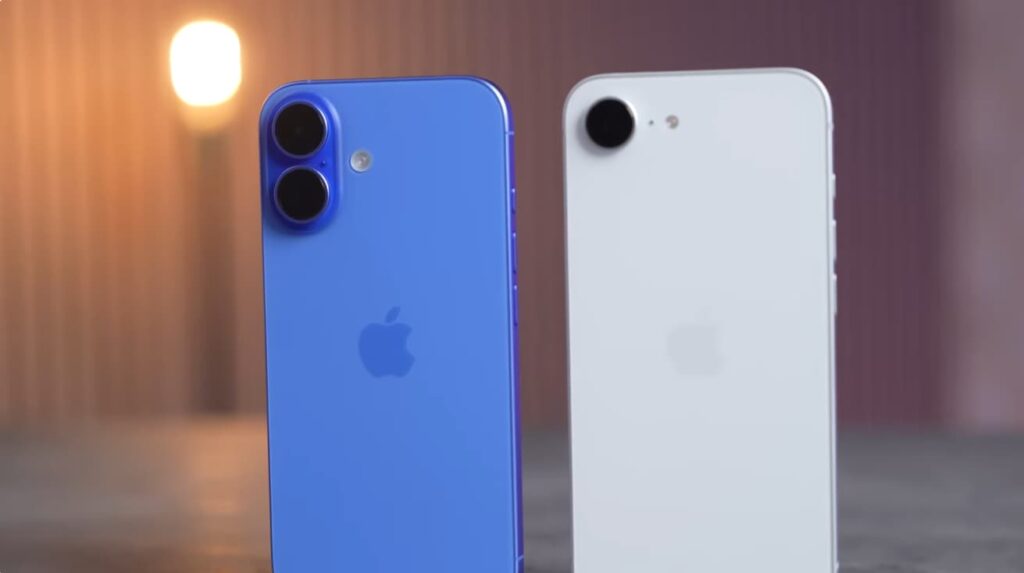
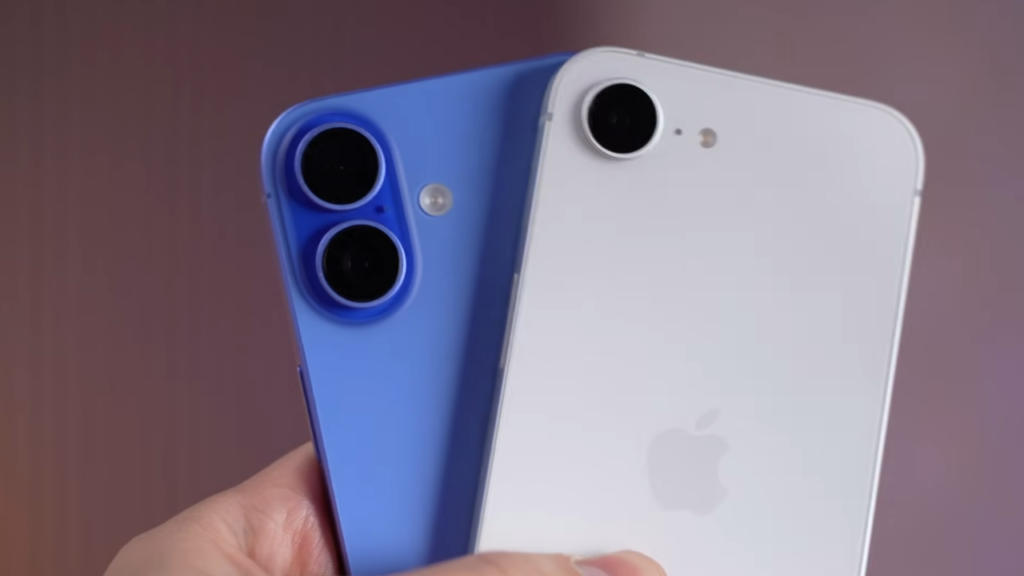
Let me start with the design, as there are quite a lot of differences here. The 16e, despite having “16” in its name, actually recycles the body of the iPhone 14. If I compare the frames, you will see that the iPhone 16 has a more rounded frame toward the edges, whereas the 16e is much sharper. They both feature a frosted glass back, which I do really like, but the iPhone 16 comes in five colors, three of which are super vibrant, as opposed to just black and white on the iPhone 16e.
There is also a pretty big difference when we take a look at the camera modules, with the iPhone 16e only having a single module as opposed to two on the iPhone 16. We will talk more about performance later. Another big difference is when we take a look at the front, where the 16e still has the old notch, whereas with the 16 we do get the Dynamic Island. All in all, I do not dislike the design of the 16e, but I cannot argue with the fact that the 16 just looks much more modern.
Display
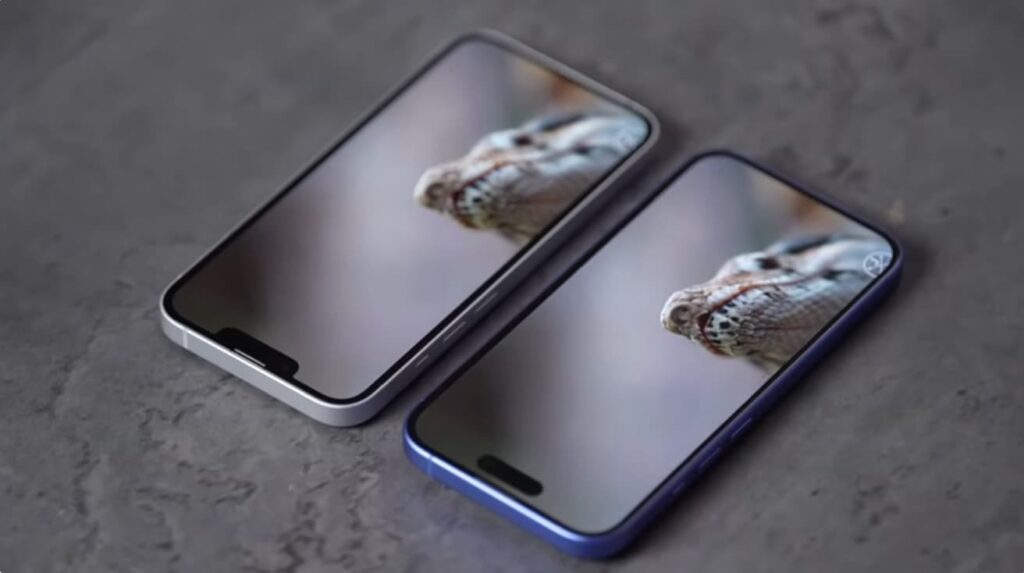
They both have a 6.1-inch panel, and as I said, the 16 comes with the Dynamic Island as opposed to the notch, so viewing content is just a bit more enjoyable on the 16, as you get fewer distractions. I also quite like having the Dynamic Island for seeing my alarms or tracking my Uber from there.
Aside from this, the 16e also seems to have ever-so-slightly thicker bezels than the 16, but really the biggest display difference between the two is brightness. On paper, the 16e can only go up to 800 nits outdoors, as opposed to 2,000 nits on the iPhone 16. Now, you do need to be in a fairly bright sunny environment for this to happen, but if you are, then the 16 will be able to boost much higher.
Camera
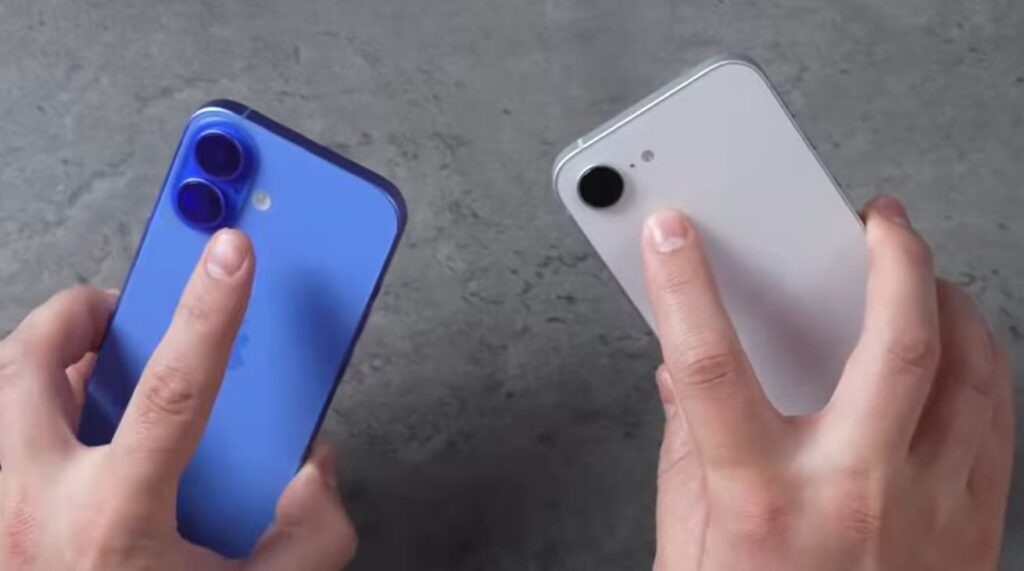
In camera, where we do actually get a lot of differences. The biggest one is, of course, the lack of an ultra-wide module on the iPhone 16e, which I think is a really bad choice from Apple. I get why they have done it, but literally any Android phone at this price range has at least two camera modules, if not even three, so the fact that we only get one on the 16e just is not great.
Even when it comes to that single camera module, even though it is 48 megapixels in resolution, the same as the iPhone 16ie is not the same sensor as on the iPhone 16. In fact, it is a smaller sensor, although one designed for the iPhone 16e specifically, according to what Apple told me at their press briefing.
Taking a look at some samples, they actually look very similar in terms of image processing pretty much identical. Strangely enough, once we zoom in, the 16e is the one that appears sharper, although it looks to be simply an image-processing choice here. The same thing happens in another sample where the 16e once again seems to have more sharpness if we zoom in, although it also has more noise.
If we take a look at some night samples, the 16 is quite a bit clearer. The same thing appears in the lower-light shot, where the larger sensor on the iPhone 16 does make a substantial difference when it comes to the overall detail that we get. Luckily, the front-facing camera is literally the same, so there is no difference here at all.
If we take a look at the video performance, it is pretty much identical to the iPhone 16 aside from one big difference: when you have a lot of motion, such as walking or running, the iPhone 16e is going to be less stable than the iPhone 16, since its sensor is not stabilized like the iPhone 16’s is.
On top of not having an ultra-wide module and the main module being inferior, we also miss out on a bunch of camera features. For example, there is no support for macro at all, which is something that the ultra-wide module gives us. There is also no support for spatial video, which we also need the ultra-wide module for, and surprisingly there is also no Action Mode or Cinematic Mode, which I am assuming is because of only having a single module as well. For some reason, we are also lacking the more advanced photographic styles that the iPhone 16 has, even though this seems to be a purely software feature. So, while the camera is fine for $600, Apple could have at least given it the same sensor as the iPhone 16 rather than a downgraded one.
Performance
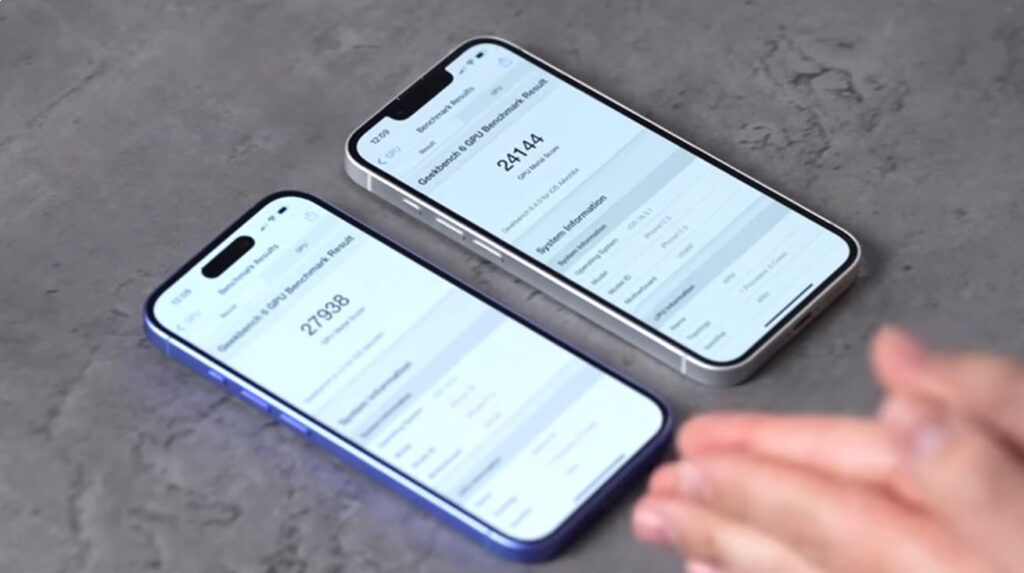
On paper, the iPhone 16e comes with the same A18 chip and 8GB of RAM as the iPhone 16, but in fact the 16e’s A18 chip comes with one less GPU corefour instead of five. If we test the CPU performance, you will see that in single-core it is pretty much the same as the 16. In multi-core, the 16e surprisingly scores 100 points higher; I am not really sure why this is the case. However, if we do a GPU test, you will see that the iPhone 16 scores 16% higher thanks to that additional GPU core, so there is a pretty notable difference here.
Will this impact gaming performance? It is a bit hard to say, but Apple did tell me that all major AAA titles, such as Assassin’s Creed Mirage, should still run and feel just like they do on the iPhone 16, and I can confirm that Assassin’s Creed Mirage does indeed run very well here.
Battery
When it comes to the batteries, this is where things get really strange, because the iPhone 16e actually comes with a larger battery than the iPhone 16, which is said to be around 3,900 mAh compared to 3,500. Thanks to that, and also Apple’s brand-new C1 5G modem that is inside, we actually get four extra hours of video playback on the 16e for a total of 26 hours compared to 22. In fact, the 16e has a very similar battery life to the iPhone 16 Plus despite its much smaller size. This is really impressive.
Sure, the larger battery does play a part in this too, but the real difference is made by that C1 modem, which is the most efficient modem ever used in an iPhone. Back in 2019, Apple bought Intel’s 5G modem division for $1 billion, and six years later and probably billions more in R&D costs we got the C1 modem, which is likely just the start of some fairly major battery-life gains in future Apple products as well.
However, Apple decided not to give the 16e MagSafe, which is, in my opinion, the biggest deal breaker of this phone. You can buy a case with a MagSafe ring built in, but wireless charging will still be locked to 7.5 watts as opposed to 15 watts on the iPhone 16.
Features and Connectivity
When it comes to features, surprisingly the 16e does have the Action Button, something I was not expecting to see here. Unlike the iPhone 16, you can also configure it to trigger Apple Visual Intelligence. The iPhone 16 does this through the Camera Control button, which in addition to the Action Button lets you quickly launch the camera and adjust camera settings by half-pressing it. Personally, I actually disabled this on my iPhone 16 Pro Max because I ended up accidentally messing up some of my settings when I was just holding the phone in portrait mode, so I do not think that is a huge loss for the 16e.
We also get the exact same Apple Intelligence features on the 16e as on the 16, things such as Writing Tools, Genmoji, or Cleanup in Photos are all there. For me, the most useful Apple Intelligence feature has definitely been notification summaries, which we do get on both phones. The speakers sound the same as well.
There are also some connectivity aspects that have been downgraded on the iPhone 16e, such as only having Wi-Fi 6 as opposed to Wi-Fi 7. More importantly, it also lacks the Ultra-Wideband chip, so if you have an AirTag, you are not going to get the accurate Precision Finding feature and will instead rely only on Bluetooth.
Conclusion (iPhone 16e vs iPhone 16)
Having said all of this, it is pretty clear that the iPhone 16e does actually lack quite a lot compared to the iPhone 16, and honestly I do think that the main reason why the iPhone 16e even exists is to push more people toward the iPhone 16. At the end of the day, getting a refurbished iPhone 15 Pro for around $600 may actually be the best choice, as you get a triple-camera module, a 120Hz display that is much brighter, and you still get all the Apple Intelligence features with it. If you do not want to buy a refurbished phone, then I would still go with the iPhone 16 over the 16e.
Discover Also Vivo X300 Pro vs OPPO Find X9 Pro: Let’s Check Who’s Better
Discover more from Phoonomo
Subscribe to get the latest posts sent to your email.