When Google announced the Pixel 8 Pro, it immediately raised a common question among fans: how different is it from last year’s Pixel 7 Pro? On paper, both devices look similar, but small refinements can often make a big difference in day-to-day use. To help you decide, we’ll go through each category design, display, software, performance, battery, and cameras and see whether upgrading to the new Pixel makes sense.
Quick Comparison
| Specification | Google Pixel 8 Pro | Google Pixel 7 Pro |
|---|---|---|
| Display | 6.7″ LTPO OLED, flat, 120Hz, 1,600 nits | 6.7″ LTPO OLED, curved, 120Hz, 1,000 nits |
| Chipset | Google Tensor G3 | Google Tensor G2 |
| Software | 7 yrs updates | 5 yrs (1 passed) |
| Battery | ~5,000 mAh, better endurance | ~5,000 mAh |
| Charging | 53% in 30 min | 46% in 30 min |
| Cameras | 50+48+48 MP, AF selfie | 50+12+48 MP, fixed selfie |
| Build | Victus 2, IP68 | Victus, IP68 |
| AnTuTu | ~1.14M | ~981K |
| Geekbench 6 | 1,760 / 4,442 | 1,407 / 3,385 |
| Price | Premium | Lower |
Design and Build
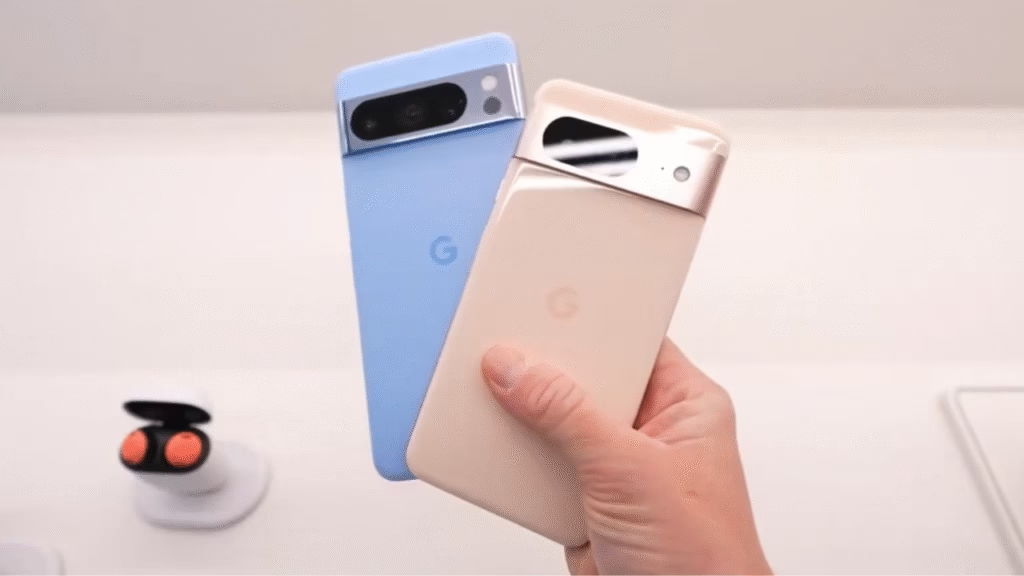
At first glance, the Pixel 8 Pro and Pixel 7 Pro share Google’s signature look. Both carry the recognizable visor-style camera bar across the back and come with an IP68 water and dust resistance rating. The backs are flat, giving them a sturdy and modern appeal.
The difference is in the details. The newer Pixel 8 Pro is protected by Gorilla Glass Victus 2, a stronger glass that offers better resistance to drops on hard surfaces. The Pixel 7 Pro, on the other hand, uses the earlier Victus glass. While both feel premium in hand, that extra durability on the 8 Pro can give peace of mind if you tend to drop your phone.
Another small but noticeable change is the screen shape. The Pixel 7 Pro features a curved display, while the Pixel 8 Pro switches to a flat panel. For some, curved edges look sleek, but many users prefer the flat design for better handling and fewer accidental touches.
Display Quality
Both phones sport a 6.7-inch LTPO OLED panel with a 120Hz refresh rate, so scrolling and animations feel smooth on either device. Resolution is nearly identically sharper on the Pixel 7 Pro at 512 pixels per inch versus 489 on the Pixel 8 Pro. In practice, your eyes won’t notice the difference.
Where the Pixel 8 Pro really stands out is brightness. With manual settings, it can reach close to 1,000 nits, and in auto mode, it peaks around 1,600 nits. That makes it easier to see in direct sunlight or bright outdoor settings. The Pixel 7 Pro maxes out at around 1,000 nits with auto boost, which is fine but less impressive.
Another refinement is refresh rate control. Both displays can slow down when showing static content to save power, but the Pixel 8 Pro can drop all the way to 1Hz, compared to the 7 Pro’s 10Hz minimum. That small change improves battery efficiency.
Software and Updates
Software has always been one of Google’s strongest points, and both of these phones deliver a clean, stock Android experience. They come with unique AI-driven features, such as Magic Eraser for photos and real-time transcription in the Recorder app.
However, the Pixel 8 Pro pulls ahead with its update promise. Google guarantees seven years of software support, which is an industry-leading commitment. That means security updates and new features well into the next decade. The Pixel 7 Pro launched with a five-year promise, but one of those years is already gone, leaving it with four more.
For users who like to keep their phones for a long time, this extended support could be the single biggest reason to choose the newer model.
Performance and Hardware
Under the hood, the Pixel 7 Pro runs on Google’s Tensor G2 processor, while the Pixel 8 Pro introduces the Tensor G3. The G3 is more capable, with improvements in efficiency, machine learning, and AI tasks. Still, if you’re expecting benchmark numbers that rival Snapdragon or Apple’s A-series chips, you may be disappointed. Google has made it clear that its focus is optimization, not chasing raw power.
For everyday usebrowsing, social media, streaming, and multitasking both phones feel smooth and reliable. Gamers may notice that other flagship devices outperform the Pixels in frame rates, but for most users, the difference isn’t critical.
When it comes to performance, benchmarks give us a clearer picture of how these two Pixels stack up. On AnTuTu v10, the Pixel 8 Pro scores around 1.14 million, a healthy jump over the Pixel 7 Pro’s ~981,000. That boost shows Google’s new Tensor G3 chip offers more raw power and better efficiency compared to last year’s Tensor G2. Geekbench 6 results tell a similar story: the Pixel 8 Pro delivers about 1,760 points in single-core and 4,442 in multi-core, while the Pixel 7 Pro comes in at 1,407 and 3,385 respectively. GPU benchmarks also tilt in favor of the newer model, with the Pixel 8 Pro showing stronger Vulkan and OpenCL scores. In everyday use the difference isn’t night and day, but if you care about gaming or heavy multitasking, the newer Pro does hold a measurable edge.
Battery and Charging
Both devices carry a similar 5,000 mAh battery capacity. Yet thanks to its more efficient chipset and adaptive refresh rate, the Pixel 8 Pro lasts a bit longer. In endurance tests, it reached around 90 hours, compared to 83 hours on the Pixel 7 Pro.
Charging speed remains modest by today’s flagship standards. With wired charging, the Pixel 8 Pro gets to about 53% in half an hour, while the Pixel 7 Pro reaches 46% in the same time. Wireless charging and reverse wireless charging are supported on both, so you can top up your earbuds or another phone if needed.
Cameras and Photography
Cameras are the centerpiece of Google’s Pixel lineup, and here’s where subtle upgrades shine.
The Pixel 7 Pro has a triple setup:
- 50MP main camera
- 48MP telephoto with 5x zoom
- 12MP ultra-wide
The Pixel 8 Pro keeps the formula but refines it:
- 50MP main camera with a brighter lens
- 48MP telephoto with slightly different zoom characteristics
- 48MP ultra-wide, a big jump in resolution
In daylight, the differences aren’t dramatic, but the Pixel 8 Pro edges ahead with cleaner detail and more consistent sharpness, especially from the ultra-wide camera. At night, improvements become more visible. The main sensor captures slightly cleaner shots, the telephoto retains a bit more sharpness, and the ultra-wide handles noise much better.
Video performance also improves on the Pixel 8 Pro. Its footage from the main, telephoto, and ultra-wide cameras looks sharper and better balanced in both bright and low-light conditions. The selfie camera on both models is 10.5MP, but the 8 Pro adds autofocus, which helps deliver consistently sharp results at varying distances.
Audio and Speakers
Both models come with stereo speakers, but there’s a difference in character. The Pixel 7 Pro has louder output, while the Pixel 8 Pro offers a more balanced sound profile with better quality. Depending on your preference or clarity you might favor one over the other, but neither will disappoint for everyday media use.
Price and Value
As expected, the Pixel 7 Pro now comes at a lower price since it’s last year’s model. For those looking to save money, this makes it an appealing choice. You still get an excellent display, strong cameras, and a polished Android experience.
The Pixel 8 Pro, on the other hand, justifies its higher cost with subtle but meaningful refinements: a brighter flat display, longer battery life, improved camera performance, and, importantly, seven years of software updates. For users who plan to keep their phone for many years, that long-term support can outweigh the initial savings.
Verdict
So, which one should you choose?
If budget is your top priority, the Pixel 7 Pro remains a fantastic option. It offers a powerful camera system, smooth software, and an elegant design at a more affordable price than ever.
But if you want the latest refinements, care about longer software support, and appreciate the upgrades in display brightness, battery efficiency, and camera performance, then the Pixel 8 Pro is worth the investment. It may not reinvent the Pixel formula, but it polishes it in ways that matter for daily use.
In short: the Pixel 7 Pro is the value pick, while the Pixel 8 Pro is the smarter long-term choice.
Want to know about Google Pixel 6 Pro vs Google Pixel 7 Pro Specs, Features and Experience
FAQs
What is the main difference between Google Pixel 8 Pro and Pixel 7 Pro?
The Pixel 8 Pro comes with a newer Tensor G3 chipset, a brighter flat display, better battery life, longer 7-year software support, and upgraded camera sensors. The Pixel 7 Pro, while older, still offers strong performance and is more affordable.
Which phone has the better display?
Both phones use 6.7-inch LTPO OLED panels with 120Hz refresh rates, but the Pixel 8 Pro gets much brighter at up to 1,600 nits, making it easier to see in direct sunlight.
How do the benchmark scores compare?
On AnTuTu, the Pixel 8 Pro scores about 1.14 million, while the Pixel 7 Pro manages around 981,000. Geekbench 6 also shows the Pixel 8 Pro ahead in both single-core and multi-core results, confirming its stronger performance.
Do both phones support wireless charging?
Yes. Both models support fast wireless charging as well as reverse wireless charging, so you can top up accessories like earbuds on the back of the phone.
What about camera improvements?
The Pixel 8 Pro has a brighter main lens, a sharper ultrawide sensor, and autofocus on the selfie camera. In day-to-day photos, both are excellent, but the 8 Pro captures cleaner details in low light and sharper video overall.
Which one is better for long-term use?
The Pixel 8 Pro is better for longevity since it comes with seven years of software updates, compared to the Pixel 7 Pro’s five years (with one already used). If you want a phone that will stay updated longer, the 8 Pro is the safer bet.
Is the upgrade worth it?
If you already own a Pixel 7 Pro, the differences might feel incremental—mainly in performance, camera refinements, and display brightness. But if you’re buying fresh and budget allows, the Pixel 8 Pro gives you more future-proofing.

M Adnan Akram is the founder and lead writer at Phoonomo, covering mobile technology with a primary focus on Apple and the broader smartphone industry, alongside emerging developments in AI. He follows product launches, spec leaks, and industry trends closely to keep readers informed with timely updates.
Discover more from Phoonomo
Subscribe to get the latest posts sent to your email.